


Memory and focus
The best-studied lion’s mane benefits concern memory. In a Japanese trial, adults aged 50 to 80 with mild cognitive impairment who took lion’s mane (Hericium erinaceus) every day scored higher than the comparison group from week 8, and the gap held to week 16. Smaller studies point to faster attention in healthy adults. Consistency is what counts.
If you live in Rabat or Casablanca and work long days, you have probably seen it on a colleague’s desk or in a podcast. It looks nothing like a herb. It is a white mushroom that hangs in soft spines, a bit like a lion’s mane, and in Japan it is called yamabushitake.
We prefer numbers to adjectives. So here is what each human study gave, to how many people, for how long, and what changed.
محتوى الصفحة
- 1 Key points
- 2 In this guide
- 3 What is lion’s mane mushroom?
- 4 Lion’s mane benefits: what human trials measured
- 5 How lion’s mane works
- 6 How long does lion’s mane take to work?
- 7 What is the best dose? Capsules, powder or tea
- 8 Lion’s mane side effects: who should be careful?
- 9 Lion’s mane in Morocco: price and offers
- 10 Frequently asked questions about lion’s mane
- 11 Order your lion’s mane
- 12 Sources and method
Key points
- What it is: an edible mushroom whose fruiting body and mycelium contain hericenones and erinacines.
- Memory: in 30 people with mild cognitive impairment, the lion’s mane group beat the comparison group at weeks 8, 12 and 16.
- Timeline: think in weeks; the favourable results appeared between week 8 and week 16.
- Our dose: one 500 mg extract capsule a day with a meal, 60 capsules per box.
- Caution: skip it if you are allergic to mushrooms, and ask your doctor if you take medication or are pregnant.
What is lion’s mane mushroom?
Lion’s mane is an edible mushroom, Hericium erinaceus, also known as yamabushitake or hedgehog mushroom. It grows on tree trunks, is cooked fresh in East Asian kitchens and, dried or extracted, goes into food supplements. Researchers are interested in it because of compounds studied in connection with the nervous system and cognition.
Two parts of the mushroom keep coming up. The fruiting body is the white mass you see and eat. The mycelium is the network of fine threads it grows from, inside wood or, on farms, on grain. A 2025 systematic review ties erinacines to the mycelium, while hericenones are linked to the fruiting body.5 A Japanese team notes that both families of compounds stimulate the synthesis of nerve growth factor (NGF), a protein neurons need to grow and maintain themselves.3
That is where the memory story starts.
Fruiting body vs mycelium
You will see both on labels. Neither is “the right one” on the evidence we have: the trials below used fruiting-body supplements, dried mushroom powder or food made with the mushroom, and none compared the two parts head to head. What matters more for you is a label that states the amount per capsule clearly.
Lion’s mane benefits: what human trials measured
The best-documented benefit of lion’s mane is on memory and cognitive function. The clearest results come from trials of 12 to 16 weeks, mostly in people over 50. In healthy adults, one small study found faster performance on an attention test. For mood and stress, there are early signals and nothing firmer yet.
The table sums up each study using the figures in its PubMed abstract. For the bigger picture on focus, from sleep to food, see our guide to memory and focus: the habits and nutrients that support your mental performance.
| Study | Who | What they took, and for how long | What was measured and found |
|---|---|---|---|
| Mori et al., 20091 | 30 people aged 50 to 80 with mild cognitive impairment | Four 250 mg tablets (96% dried mushroom powder) three times a day, 16 weeks | Higher scores than the comparison group on the HDS-R cognitive scale at weeks 8, 12 and 16 |
| Saitsu et al., 20192 | Adults, randomised double-blind trial | Fruiting-body supplement, 12 weeks | Significant improvement on the MMSE, one of three tests used |
| Docherty et al., 20234 | 41 healthy adults aged 18 to 45 | 1.8 g a day, a first dose then 28 days | Faster Stroop task 60 minutes after the first dose; a trend towards less perceived stress at 28 days |
| Nagano et al., 20103 | 30 women | Cookies made with the mushroom, 4 weeks | Lower depression (CES-D) and general complaint (ICI) scores than at baseline |
| Menon et al., 20255 | Systematic review of 5 randomised trials, 3 pilot trials and lab studies | Varied | Across one randomised and one pilot trial, MMSE up by a weighted mean of 1.17 points |
Memory after 50
Mori’s team split 30 Japanese men and women with diagnosed mild cognitive impairment into two groups of 15. One group took lion’s mane tablets for 16 weeks; the other took identical tablets without the mushroom.1 Scores in the lion’s mane group rose the longer people took it, and the difference was significant at weeks 8, 12 and 16. Lab tests showed no adverse effects.
Then they stopped. Four weeks later, their scores had dropped significantly.
The lesson is practical: the effect the study measured came with regular intake and did not outlast it.
The MMSE and “1.17 points”
The MMSE is a 30-point test doctors use to check memory, attention and orientation. In Saitsu’s trial, 12 weeks of a fruiting-body supplement significantly improved MMSE scores, and the authors write that it also slowed their decline.2 Pooling two trials, the 2025 review found an average rise of 1.17 points.5
Focus in healthy adults
Docherty’s pilot study recruited 41 healthy adults aged 18 to 45, the kind of people who want sharper focus before an exam or a big meeting.4 An hour after a first 1.8 g dose, they completed the Stroop task faster. In that test you see the word “red” printed in blue and must name the colour, not the word. It is small. The authors themselves ask for larger trials. Still, it is a first signal in people without memory problems.
Is lion’s mane good for anxiety?
The signals are early. In Nagano’s study, 30 women ate cookies with or without lion’s mane for 4 weeks; afterwards their depression and general complaint scores were lower than at the start, and two items, “palpitations” and “insensitivity”, were lower than in the comparison group.3 Docherty’s group saw a trend towards less perceived stress after 28 days.4 Worth watching. No more than that.
How lion’s mane works
Nobody has pinned down the full mechanism. The most studied idea involves two proteins the brain needs to grow and connect its neurons: nerve growth factor (NGF) and brain-derived neurotrophic factor (BDNF). In lab work, compounds from the mushroom raised the production of both, which is why scientists went on to test it in people.
The 2025 review reports that, in the studies it gathered, lion’s mane increased BDNF and encouraged new neurons in the hippocampus, the part of the brain tied to memory.5 Most of that comes from the lab and from animals. It explains the interest; it does not replace human trials. Either way, these are slow processes that take weeks to build up before they show in a test, or in an ordinary workday when you finish a report without losing the thread every ten minutes. Your nervous system also relies on other nutrients, covered in our article on B vitamins, energy and the nervous system.
How long does lion’s mane take to work?
In the longest trial, the first significant difference appeared after 8 weeks of daily use, and scores peaked at week 16. The VitalisPro label advises two to three months of continuous use before you judge the result. Plan for at least three months, without a break.
Picture a student starting in February for exams in June, or someone starting two months before Ramadan, when fasting makes the afternoon meetings feel longer. Both give the mushroom the time the studies gave it. Starting a week before the exam asks it for something no long trial measured.
| When | What the studies recorded | What we suggest |
|---|---|---|
| 60 minutes after the first dose | Faster Stroop task in healthy adults (1.8 g)4 | Do not judge on one day |
| 4 weeks | Trend towards less stress; lower depression scores in the cookie study3 | Keep going |
| 8 weeks | First significant difference on the cognitive scale1 | First box finished: start the second straight away |
| 12 weeks | MMSE improvement2 | Note what you notice day to day |
| 16 weeks | Best scores in Mori’s trial1 | Time to take stock |
| 4 weeks after stopping | Scores fell again1 | Regularity keeps what you built |
What is the best dose? Capsules, powder or tea
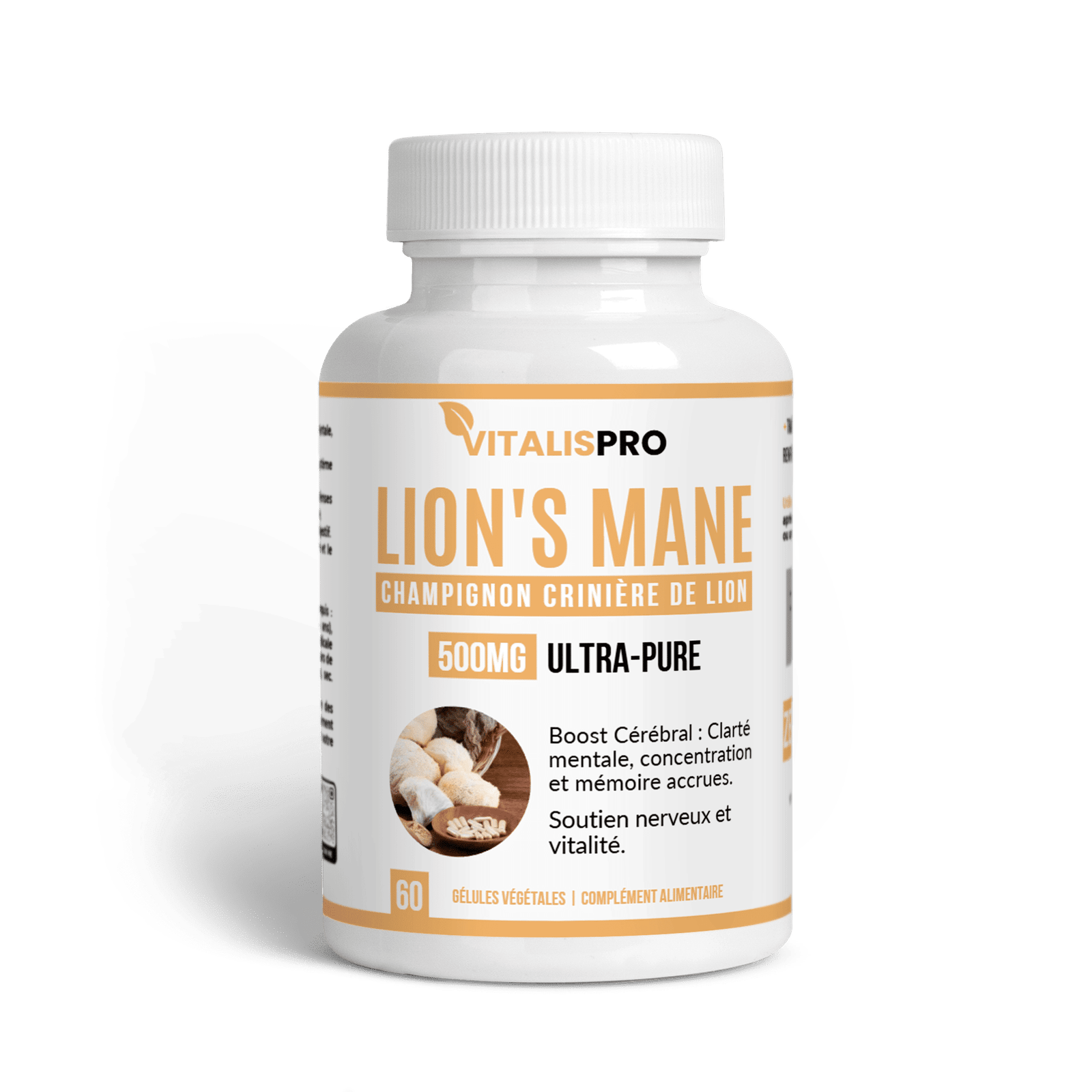
For VitalisPro Lion’s Mane, take one capsule of 500 mg extract a day with a meal and a glass of water, without exceeding the recommended dose. The trials used grams of dried mushroom powder, or foods containing it, which is a different measure from milligrams of extract.
The published amounts: about 3 g a day of powder tablets in Mori’s trial, 1.8 g a day in Docherty’s, cookies in Nagano’s.143
Powder goes into coffee or a smoothie; tea is brewed from dried pieces. Both are fine. The catch is the same: nobody really knows how much they took on the morning they stirred a spoonful into their cup before rushing for the tram, then forgot the next day, then picked it up again a week later, which is why so few people keep it up for sixteen weeks. A capsule gives you the same amount every day, printed on the box.
What takes no effort is what you keep doing.
Each VitalisPro capsule contains 500 mg of lion’s mane extract (Hericium erinaceus) in a plant-based cellulose shell instead of animal gelatine, with plant-sourced magnesium stearate as a manufacturing aid that helps the powder flow during filling. Nothing else. Tie it to a fixed meal, perhaps the lunch you finish with a glass of mint tea, and do not double the dose to speed things up: no study tested that.
Can I take it with other supplements?
Many people pair it with reishi and spirulina. Our Reishi, Lion’s Mane and Spirulina Pack brings together three original boxes: reishi 300 mg (60 capsules), lion’s mane 500 mg (60 capsules) and spirulina (120 tablets), currently 320 DH instead of 380 DH bought separately. Each box keeps its own dose. Our guide to reishi benefits, dosage and price in Morocco explains the first of the three.
Lion’s mane side effects: who should be careful?
Lion’s mane is an edible mushroom, and in Mori’s 16-week trial, lab tests showed no adverse effects.1 The 2025 systematic review lists possible effects that are rarely reported: stomach discomfort, headache and allergic reactions.5 A mushroom allergy is the main reason to avoid it altogether. A few other situations call for care.
- Known mushroom allergy: do not take it.
- Pregnancy, breastfeeding and under-18s: there is not enough data, so talk to your doctor first.
- If you take regular medication, especially a blood thinner, ask your doctor before starting; interactions have not been well studied.
- Always take it with food, as the label says, all the more if your stomach is sensitive.
Lion’s mane is a food supplement, not a medicine. If a parent’s forgetfulness is getting worse quickly, see a doctor first; a supplement comes after, with their agreement. For the checks worth making on any supplement, read choosing a food supplement you can trust.
Lion’s mane in Morocco: price and offers
A box of VitalisPro Lion’s Mane, 60 capsules of 500 mg, currently costs 135 DH instead of 220 DH. Two boxes cost 250 DH and three boxes 330 DH. Delivery anywhere in Morocco is 30 DH, free from 170 DH, and you pay cash on delivery, with a 14-day money-back promise on sealed boxes.
| Offer | Capsules | Lasts, at one a day | Price today | You save |
|---|---|---|---|---|
| 1 box | 60 | 60 days | 135 DH + 30 DH delivery | nothing |
| 2 boxes | 120 | 120 days | 250 DH, free delivery | 80 DH |
| 3 boxes | 180 | 180 days | 330 DH, free delivery | 165 DH |
The maths: two single boxes come to 2 × (135 + 30) = 330 DH, against 250 DH in the offer; three come to 495 DH, against 330 DH. Our advice is simple. Take two boxes: 120 days roughly covers the sixteen weeks of the longest trial, delivery is free, and you will not run out halfway.
Frequently asked questions about lion’s mane
Order your lion’s mane
Pick the offer that matches how long you plan to keep going, then order on the Lion’s Mane 500 mg page. We deliver anywhere in Morocco, from Tangier to Agadir, and you pay when it arrives. Take your first capsule with breakfast tomorrow, and give it three months before you decide.
Sources and method
This article relies on the abstracts of studies indexed in PubMed, each re-read before publication. We give sample sizes, doses and durations as published.
- Mori K, et al. Yamabushitake (Hericium erinaceus) and mild cognitive impairment: a double-blind clinical trial. Phytother Res, 2009. PubMed 18844328
- Saitsu Y, et al. Improvement of cognitive functions by oral intake of Hericium erinaceus. Biomed Res, 2019. PubMed 31413233
- Nagano M, et al. Reduction of depression and anxiety by 4 weeks Hericium erinaceus intake. Biomed Res, 2010. PubMed 20834180
- Docherty S, et al. Acute and chronic effects of lion’s mane on cognitive function, stress and mood in young adults: a pilot study. Nutrients, 2023. PubMed 38004235
- Menon A, et al. Benefits, side effects, and uses of Hericium erinaceus as a supplement: a systematic review. Front Nutr, 2025. PubMed 40959699
The information in this article is provided for informational purposes, based on studies published in PubMed, and is not a substitute for advice from a qualified healthcare professional. VitalisPro Lion’s Mane is a food supplement, not a medicine: it does not replace a varied, balanced diet or a healthy lifestyle. Do not exceed the recommended dose. If you are pregnant or breastfeeding, under 18, on medication or living with a medical condition, ask your doctor before use. Keep out of the reach of children.
