


Mobility and wellbeing in daily life
With the years, simple movements we used to make without a thought — rising from a chair, climbing stairs, bending to tie a shoelace — become moments where we finally notice our joints. A little stiffness on waking, a passing discomfort after sitting for a long time, or simply a sincere wish to keep a fluid movement all day long. Joint mobility is not a luxury: it lies at the heart of independence and quality of life. And the reassuring news is that a large part of this comfort is in our own hands.
This in-depth guide from VitalisPro does not promise you a miracle and does not claim to “repair” any joint. In plain language and with verifiable sources, it explains how a joint works, what “supporting its mobility” really means, what research has shown about collagen, vitamin D and lifestyle, and where the honest limit of the evidence lies. The goal is that you leave with decisions built on knowledge, not on advertising noise.
Let us agree on one principle from the start: a joint is not an idle mechanical part waiting for “lubrication” from the outside. It is a living structure made of cartilage, fluid, ligaments and muscles that work together. Our job is not to “repair” it with a wonder product, but to give it the conditions in which it stays supple and comfortable: movement, a wise diet, good hydration and a balanced weight. It is precisely from this realistic angle that talking about supplements begins to make sense, and not a moment before.

محتوى الصفحة
- 1 In brief: what you will learn
- 2 In this guide
- 3 Why does joint mobility change with age?
- 4 Gentle movement: a daily investment in comfort
- 5 Nutrition: what supports your joints from the inside
- 6 A balanced weight: less load on your joints
- 7 Collagen: why science takes an interest in the context of joints
- 8 Vitamin D: normal bones and muscle function
- 9 Hydration and its role in the glide of the joints
- 10 Shark cartilage: a traditional source of support
- 11 A gentle routine, day after day, for comfortable movement
- 12 How to fit joint support into your routine
- 13 Precautions, interactions and limits
- 14 Stories from our readers
- 15 Frequently asked questions about joint mobility
- 16 Conclusion: comfortable movement is built day after day
- 17 Sources and methodology
In brief: what you will learn
- A joint combines movement and stability: cartilage cushions, synovial fluid lubricates, and ligaments and muscles stabilise. With age, the body’s natural production of some components of these tissues tends to slow — a natural change, not a certainty of discomfort.
- Gentle, regular movement is one of the best allies of mobility: walking, swimming and light stretching maintain range of motion and strengthen the muscles that support the joint.
- A balanced weight lightens the mechanical load on weight-bearing joints (knees, hips, ankles) and helps toward more comfortable movement over the long term.
- Collagen is studied for its role in joint tissues: controlled trials report an improvement in perceived comfort during activity, but the research is ongoing and collagen has no EFSA-approved health claim. Vitamin D, meanwhile, contributes to the maintenance of normal muscle function and of normal bones.
- VitalisPro products such as Shark Cartilage, Marine Collagen and the Bones & Joints Pack are ONSSA-authorised food supplements, meant to fit inside a healthy lifestyle. They are not medicines and not a substitute for professional advice.
Why does joint mobility change with age?
A joint is a structure of remarkable precision, uniting two opposite demands: mobility and stability. The ends of the bones are covered with a layer of smooth cartilage that acts as a shock-absorbing cushion; a fluid, called synovial, surrounds the joint, lubricates it and allows a fluid glide; and finally, ligaments and muscles give it its stability. This whole little orchestra plays in silence with every step, with every movement, without our paying it any attention.
Over the years, the body’s natural production of some components of these tissues — such as collagen — tends to slow gradually, and the suppleness of the supporting tissues may decline. This is a natural change that does not mean inevitable discomfort, but rather an invitation to finer, more conscious care. Most daily comfort comes from simple, consistent habits, far more than from a single spectacular solution.
The World Health Organization reminds us that regular physical activity is one of the major pillars of maintaining mobility and physical function as we age.1 In other words, the first key to suppleness is not in a box: it is in movement itself, the movement you repeat, gently, every day.
When do we feel a joint is “stiff”?
Because the joint works silently, we rarely “hear” it. And yet, especially in the morning or after a long stillness, many people describe a sense of stiffness, a slight cracking or a passing discomfort that fades once movement begins. These are not diagnoses: they are general signals inviting us to move more, and more regularly. The wise approach is not to hunt for a quick fix, but to build gentle habits patiently. And whenever discomfort is persistent, or there is swelling or a marked limitation, consulting a qualified healthcare professional remains the first reference.
Gentle movement: a daily investment in comfort
It might seem logical to believe that sparing your joints means avoiding movement. Yet the opposite is often true. Moderate, regular movement maintains the suppleness of the joints, strengthens the muscles that support them, and activates circulation as well as the renewal of the synovial fluid. Low-impact activities — gentle walking, swimming and light stretching — are ideal because they are kind to the joint.
The golden rule is simple: moderation and consistency matter more than intensity. Ten minutes of gentle movement each day are more useful than a violent, sporadic effort that risks tiring the joint instead of supporting it. Start gently, listen to your body, and increase the effort gradually. It is quiet regularity, not the occasional feat, that makes a real difference over the weeks.
“The best thing you can do for your joints is not to look for a product that repairs them, but to give them, each day, a little gentle movement. The joint does not need a superhero from the outside; it needs you to keep it moving, and to stop overloading it.”


Nutrition: what supports your joints from the inside
The daily plate plays an important role in the comfort and suppleness of the joints. Essential fatty acids, found in oily fish and seeds such as pumpkin seeds, take part in the body’s natural balance. Vitamin C contributes to the normal formation of collagen, the structural protein of cartilage and connective tissues — which is exactly why VitalisPro’s Marine Collagen is paired with it. Colourful fruits and vegetables provide useful plant compounds and natural antioxidants.
A varied, colourful dietary approach is a pillar of caring for the joints over the long term. The World Health Organization stresses the importance of dietary variety within a healthy lifestyle. There is no need for “exotic” foods or complicated diets: the richness of Moroccan cooking in vegetables, pulses, herbs and quality oils already offers favourable ground. It is often enough to give these dishes back the place they lost to fast food and processed sweets.
A balanced weight: less load on your joints
There is a simple and well-documented mechanical relationship: the more the weight increases, the greater the load on the weight-bearing joints, such as the knees, hips and ankles. With every step, these joints carry several times the body’s weight; the smallest excess kilo therefore translates into a repeated strain, day after day. Research has described how excess weight alters the internal balance of the knee joint, beyond the mechanical load alone.5
Maintaining a balanced weight lightens this pressure and helps toward more comfortable movement over the long term. This is not about strict numbers or harsh diets, but about a sustainable balance that combines a wise diet and regular movement. Every step toward a healthy weight is a direct step toward joints that are more at ease and a more fluid movement. Here again, it is a lever that costs nothing and weighs more than any single supplement taken on its own.
Collagen: why science takes an interest in the context of joints
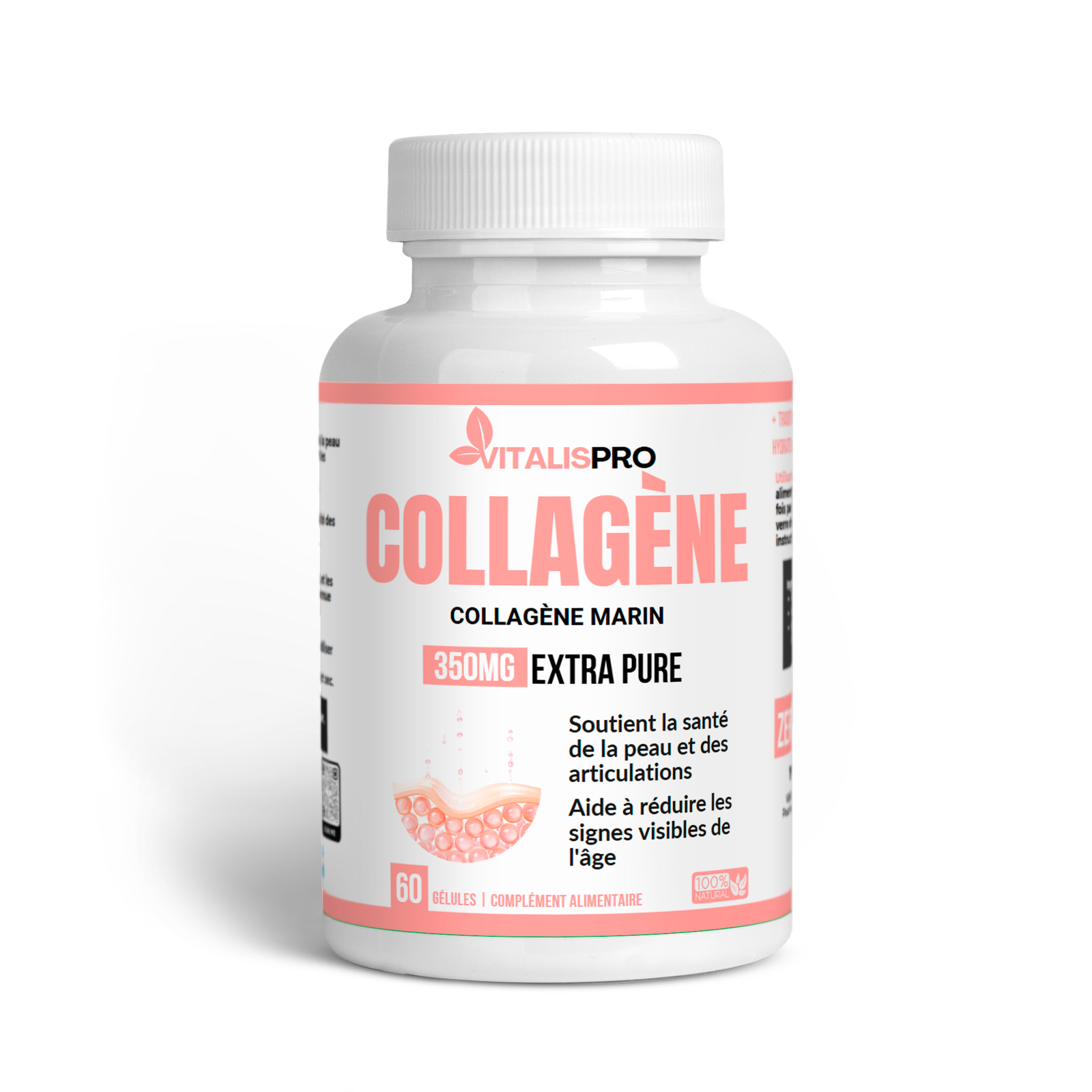
If there is one protein tied to the joints, it is collagen: the most abundant protein in the body, which forms the basic structure of cartilage, tendons and ligaments. With age, the body’s natural production tends to slow, which has drawn researchers’ interest to the possible role of supporting sources. The idea of providing the body with building blocks of collagen is exactly what explains the growing attention paid to these supplements.
So what does the science actually say? Let us be honest: the picture is encouraging but inconclusive. A meta-analysis of randomised controlled trials assessed the effect of collagen supplementation on joint symptoms and reported favourable signals on some measures, while calling for larger and more rigorous studies.2 Controlled trials have also observed an improvement in perceived joint comfort during daily activities in physically active adults after several weeks of regular collagen-peptide intake.34
Why all this caution if the signals exist? Because rigorous science distinguishes carefully between a laboratory experiment, an animal study and a clinical trial; then between a small study and a large one, and between a single result and a review pooling dozens of works. There is also an essential compliance point to recall: to this day, collagen has no EFSA-approved health claim in this context.6 We therefore present collagen for what it is: a well-known structural protein with interesting but incomplete research, to be woven into a broader wellbeing approach.
What the studies do — and do not — show
Much of this research focused on perceived comfort during movement, in athletes or active adults, over periods of several weeks — because any possible effects are gradual and cumulative, never immediate.7 This does not translate into a promise, for a healthy person, that a capsule would “repair” a joint or replace movement. Collagen belongs to a logic of support, within a whole that includes physical activity, nutrition, hydration and a balanced weight — never in their place. That balance between curiosity and caution is what we try to convey to you in every line.
Vitamin D: normal bones and muscle function
When we talk about joints, we often forget that their comfort also depends on the bones and muscles that surround and stabilise them. This is where vitamin D holds a legitimate and well-framed place. Unlike collagen, vitamin D has validated health claims: it contributes to the maintenance of normal muscle function and to the maintenance of normal bones, in line with the European regulation on claims.6 Muscles that function normally give better support to the joint, and normal bones form the framework on which all movement rests.
In Morocco, despite the sunshine, many people limit their sun exposure, which makes vitamin D intake a concrete point of attention, especially with age. This is why VitalisPro’s Bones & Joints Pack combines vitamin D3 with other supporting elements, in a logic of overall accompaniment rather than a single solution. A wise vitamin D intake also fits inside a lifestyle in which movement and nutrition remain the foundation.
Hydration and its role in the glide of the joints
We often forget water when we talk about the joints, even though its role is essential to comfort. The synovial fluid that lubricates the joints and allows their fluid glide depends on the body being well hydrated. When the body is sufficiently hydrated, this natural mechanism works with greater ease, and movement reflects it. The practical rule is simple: drink water regularly throughout the day, especially in a hot climate and during physical activity, without waiting for the feeling of thirst. Add to that water-rich foods, such as vegetables and fruit. This simple habit, alongside movement and nutrition, supports a comfortable environment for your joints — as easy to apply as it is to neglect.
Shark cartilage: a traditional source of support
Alongside collagen and vitamin D, shark cartilage is one of the traditional sources associated with joint tissues. It is rich in compounds naturally present in cartilage, which has fed interest in its use as a supplement. As with any supporting source, intellectual caution is required: we present it as one element of a wellbeing heritage, to be woven into an overall approach, and not as a tool of guaranteed effect.
What matters most here is not the name on the box, but the clarity of the formula, the quality of the source and the regulatory authorisation. That is why we always insist on ONSSA authorisation: it is not a mere formality, but a control pathway that concerns the safety and conformity of the product. A transparent source truly gives you what you think you are buying; a product of unknown origin, entering through informal channels, will never offer you that guarantee.
A gentle routine, day after day, for comfortable movement
Caring for your joints does not require a complicated programme, but gentle, consistent habits. We have gathered them for you in a simple table, to adopt at your own pace:
| The habit | Why it matters for your joints | A practical step |
|---|---|---|
| Gentle daily movement | It maintains suppleness and strengthens the supporting muscles | A quiet walk or a few stretches each day |
| Avoid prolonged stillness | Sitting for a long time stiffens the joints | Stand up and move about every 30 minutes or so |
| Varied, colourful diet | It provides the elements useful to the supporting tissues | Vegetables and fruit at every main meal |
| Adequate hydration | Water supports the fluid that lubricates the joint | Regular glasses throughout the day |
| Balanced weight | It lightens the load on the weight-bearing joints | Combine a wise diet with regular movement |
| Comfortable posture and footwear | They support the body’s alignment | Choose suitable seats and shoes |
Notice that none of these habits costs any real money: moving, drinking water, eating with balance and caring for your posture are within everyone’s reach. This is a paradox worth pausing on: the strongest thing you can offer your joints is not a product you buy, but small daily decisions you make. The supplement comes after these fundamentals, not before, and for anyone who chooses to add extra support consciously.
A few gentle, joint-friendly exercises
Maintaining suppleness requires neither a gym nor complicated equipment, but simple movements to weave into your day. Gentle stretches in the morning wake the joints and dissolve stiffness. Regular walking is an excellent low-impact activity that strengthens the supporting muscles and activates circulation. Water exercises and swimming are precious, because water carries part of the body’s weight and lightens the pressure on the joints. Finally, moderate muscle strengthening supports the stability of the joint. The rule: start gently, listen to your body, and increase the effort gradually.
How to fit joint support into your routine
Step one: start with movement, not the box
Your first “joint supporter” is your daily activity. Before buying any supplement, review a week of your days honestly: where is movement missing, where does stillness settle in, and how can you introduce a few minutes of walking or stretching? A simple adjustment here comes before everything, and it makes whatever follows far more useful.
If you decide to add a supplement, choose a formula with clear ingredients, authorised by ONSSA, from a source that is transparent in what it offers and in its price. An authorised supplement gives you a guarantee of oversight that a product of unknown origin cannot. For an overview of our full range, our shop presents the formulas designed in this spirit of accompaniment.
Step three: respect the dose and consistency
Do not exceed the recommended dose on the box thinking that “more is better”: the body responds to consistency, not to shock doses. Take the supplement usually with food and a large glass of water, and tie it to a fixed daily habit so you do not forget it. Any potential benefit is built through steady use over weeks, not through a passing capsule.

Precautions, interactions and limits
No responsible discussion of a food supplement is complete without a frank section on its limits. “Natural” is not an automatic synonym for “suitable for everyone in all circumstances,” and awareness of this is part of respecting your health. Joint-support elements are generally well tolerated in healthy adults at usual doses, but caution is required in specific situations:
- Pregnancy and breastfeeding: it is advised to avoid supplements unless recommended by a healthcare professional.
- Children under 18: supplements are not intended for this group without supervision.
- Allergy to fish or shellfish: marine collagen and shark cartilage come from marine sources; those concerned should refrain from them.
- Ongoing treatments or a known condition: consult a professional before starting, as some elements may interact with medication.
- Persistent discomfort, swelling or marked limitation: do not try to “compensate” with a supplement; the advice of a qualified healthcare professional is the priority.
We add a practical reminder that is often forgotten: do not start several new supplements at the same time. If you begin them together, it becomes hard to know what helped you and what changed nothing. The smarter method is to introduce one element at a time, and give it enough time to observe. This calm, gradual approach protects both your health and your wallet, and makes your experience clearer and more honest.
Stories from our readers
These are testimonials from people who reviewed their habits and added plant and marine support to their routine; individual experiences that differ from one person to another, which we present as they are, without exaggeration:
“In the morning I struggled to get going: my knees were stiff after the night. I did not look for a miracle; I added a short daily walk and a few stretches, with marine collagen at mealtime. After a few weeks, I feel more at ease in my movements. No magic, but a difference I can feel.” — Naima, Fes
“What I liked was the honest message: no promise of a cure, just support within a lifestyle. I have been following the Bones & Joints Pack for two months, walking more, and my everyday comfort has improved.” — Hicham, Casablanca
“Ordering was easy, with cash on delivery, and the formula is clear and ONSSA-authorised. I appreciate that it is natural and transparent, and I reordered.” — Fatima-Zahra, Agadir
Frequently asked questions about joint mobility
Conclusion: comfortable movement is built day after day
The essential message of this guide is that comfortable movement, at any age, is not the fruit of chance, but of gentle, consistent habits. Moderate, regular movement, a varied and colourful diet, a balanced weight and good hydration — these are the real pillars of your joints’ comfort. It is they, above all, that make the difference.
Within this frame, supporting elements such as marine collagen, shark cartilage and vitamin D come to complete this base, not to replace it. Use them with realistic expectations and patience, within a conscious lifestyle. And if you notice persistent discomfort despite all this, the advice of a qualified healthcare professional remains the wisest step. Your joints’ suppleness is a project you build through your daily gestures: one comfortable step after another. For direct contact, the VitalisPro team is available through our team page and our contact page.
Sources and methodology
This guide relied on a review of documented general scientific sources (PubMed databases) and published systematic reviews, in addition to official bodies such as the World Health Organization (WHO) and the European Food Safety Authority (EFSA). We committed to presenting results at their true size: promising signals are presented as signals, not as definitive promises, and no therapeutic effect was claimed. The information here is for health education, not for diagnosis or a medical prescription.
References
- World Health Organization (WHO) — Physical activity, fact sheet. who.int
- Effect of collagen supplementation on osteoarthritis symptoms: a meta-analysis of randomised placebo-controlled trials (2019). PubMed 30368550
- Improvement of activity-related knee joint discomfort following supplementation of specific collagen peptides (2017). PubMed 28177710
- The influence of specific bioactive collagen peptides on knee joint discomfort in young physically active adults: a randomised controlled trial (2021). PubMed 33562729
- Pathophysiology of obesity on knee joint homeostasis (2016). PubMed 26812879
- European Food Safety Authority (EFSA) — health claims (including vitamin D). efsa.europa.eu
- 24-Week study on the use of collagen hydrolysate as a dietary supplement in athletes with activity-related joint pain (2008). PubMed 18416885
The information in this article is provided for informational purposes for health education, drawing on documented general scientific references (PubMed, WHO and EFSA), and is not a substitute for consulting a qualified healthcare professional. Joint-support products are food supplements that do not replace a varied, balanced diet or a healthy lifestyle, and are not intended to diagnose, treat, cure or prevent any condition. Do not exceed the recommended dose. Pregnant and breastfeeding women, children under 18, and people with medical conditions or ongoing treatments are advised to consult a professional before use. Keep out of the reach of children.
