


Wellbeing and natural vitality
For thousands of years, ginseng has held a special place in the traditions of Asia, where its root was used to support vitality and to hold up against the fatigue of daily life. Today that root is back in the spotlight, but this time under the researchers’ lens. Does ginseng truly deserve its reputation? And what do recent studies say about its role in supporting focus and energy?
This guide from VitalisPro does not sell you a miracle, and it does not promise “instant energy.” Instead, in plain language and with sourced references, it explains what ginseng (Panax ginseng, Korean red ginseng) really is, what research has shown around mental vitality (focus, clarity) and physical vitality (energy, reduced feelings of fatigue), and where the honest limit of the evidence lies. The goal is that you leave with a decision built on knowledge, not on advertising noise.
Let us agree on one principle from the start: ginseng is not a magic potion that replaces sleep, nutrition or physical activity. It is an ancient plant, now studied as an element of support within a balanced lifestyle. It is precisely from this realistic angle that talking about this root begins to make sense, and not a moment before.
محتوى الصفحة
- 1 In brief: what you will learn
- 2 In this guide
- 3 Why ginseng? An ancient root under the lens of science
- 4 Ginsenosides: the key behind ginseng’s effects
- 5 What research says about mental vitality
- 6 Physical vitality and the sense of energy
- 7 Not all ginsengs are the same
- 8 Ginseng in the Moroccan context
- 9 How to fit ginseng into your routine
- 10 Precautions, interactions and limits
- 11 Stories from our readers
- 12 Frequently asked questions about ginseng
- 13 Conclusion: what do we take from all this?
- 14 Sources and methodology
In brief: what you will learn
- Ginseng (Panax ginseng) is an “adaptogen”: a plant whose ability to help the body cope with the various pressures of daily life is being studied.
- Its active compounds, the ginsenosides, exist only in ginseng; their concentration varies with the type of plant, its age and its preparation, which is why the quality of the extract matters as much as the name on the box.
- On mental vitality, several studies report promising signals around attention and clarity, but the evidence remains inconclusive and calls for more research.
- On physical vitality, ginseng is studied for its possible role in reducing the feeling of fatigue and supporting general vitality; here too, it is support, not a remedy.
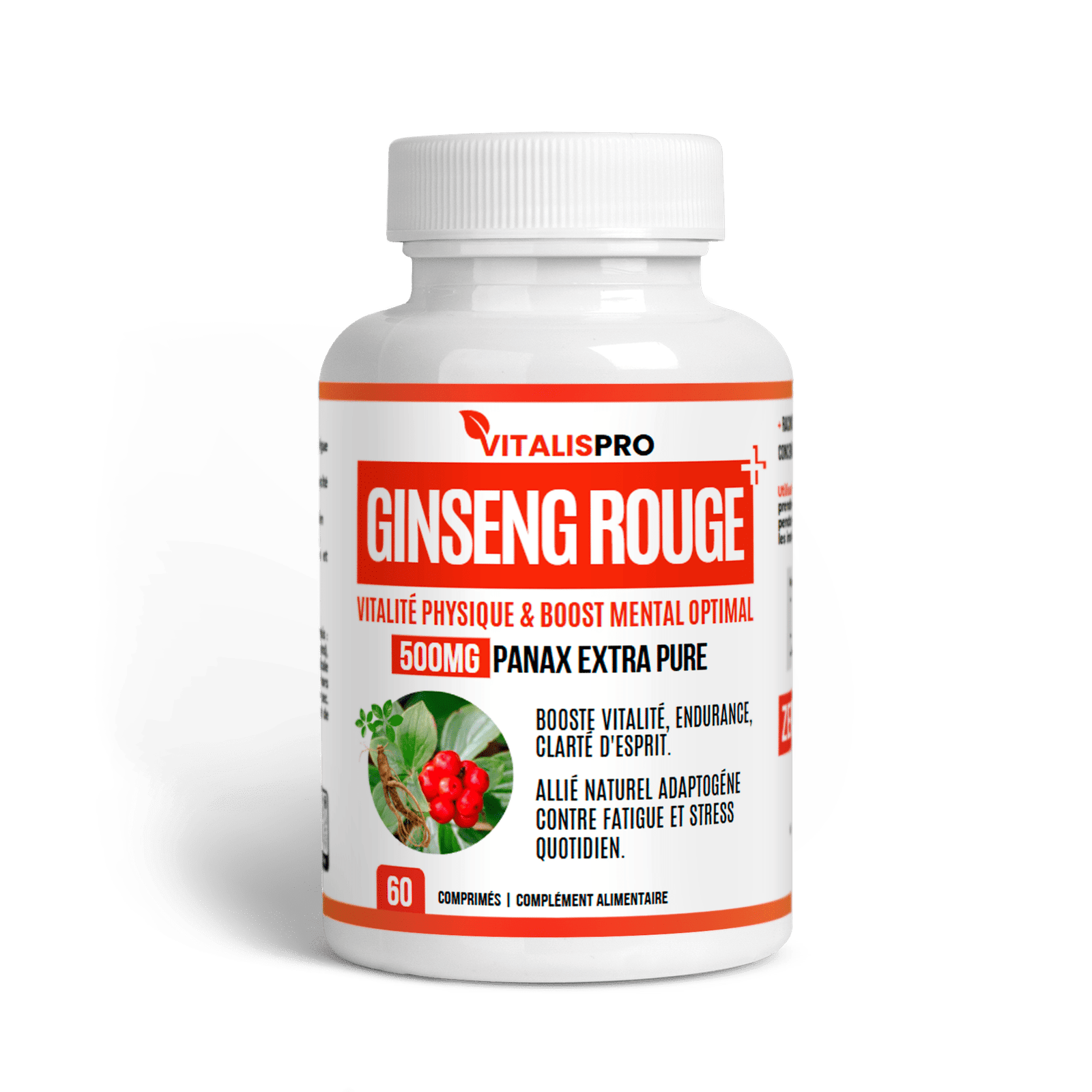
- VitalisPro products such as Red Ginseng 500 mg and the Men’s Vitality Pack are ONSSA-authorised food supplements, meant to fit inside a healthy lifestyle. They are not medicines and not a substitute for professional advice.
Why ginseng? An ancient root under the lens of science
Ginseng is a rooted plant belonging to the Panax genus, whose best-known varieties are Korean (Asian) ginseng and American ginseng. The Greek word Panax itself means “heal-all” — a name that reflects the plant’s historical standing in popular culture, not a proven property. What interests scientists today is something else entirely: its wealth of active compounds called ginsenosides, responsible for most of its studied effects.
Ginseng is classed among what are called adaptogens: elements whose ability to help the body adapt to different forms of pressure, physical and mental, is under study. One review examined the multiple constituents of ginseng and their actions in humans, underlining the diversity of its compounds and the need to carefully distinguish the levels of evidence.2 This is an honest starting point: ginseng interests researchers, but the enthusiasm must stay anchored to the data.
Let us bring the picture closer with a simple image. An adaptogenic plant does not behave like a switch that “turns on” energy on demand. It is better described as a quiet support: an element that, under certain conditions, might help the body cope better with periods of load. This nuance is crucial, because it separates the marketing promise (“a capsule that makes you tireless”) from the quieter, more honest scientific reality. It also explains why serious researchers speak in careful, measured terms rather than sweeping claims: an adaptogen is studied for how the whole body responds over time, not for a single dramatic effect you can feel within an hour.
An ancient use is not modern proof
It is tempting to conclude: “if ginseng has been used for thousands of years, it must work.” But the antiquity of a use is a hint of interest, not a demonstration of effectiveness. Modern science asks for more: controlled trials, comparison groups, objective measurements. That is why we present ginseng for what it is — a venerable traditional plant with active but still unfinished research — without loading it with promises the studies have not made.
Ginsenosides: the key behind ginseng’s effects
Ginsenosides are a group of unique plant compounds found only in the ginseng plant. Their amount and nature vary with the type of plant, its age and its method of preparation. For this reason, the quality of the final product is directly tied to the concentration of these compounds. Much research links ginsenoside content to the strength of the effects observed in studies, which makes standardisation an important criterion for evaluating any supplement.
This is a point many people overlook: the word “ginseng” on a box is not enough. A powder of unknown origin may contain only a trace of active compounds, while an extract with a clear, declared formula gives you what you actually think you are buying. This difference between a product worth its price and one that offers nothing is the heart of the quality principle VitalisPro commits to. It is also why we always insist on regulatory authorisation from ONSSA: it is not a formality, but a control pathway that concerns the safety and conformity of the product.
“The name of a plant on the label says nothing about its real value. What matters is the concentration of active compounds, the clarity of the dose, and the transparency of the origin. The rest is just a promise.”
What research says about mental vitality
One of the most studied areas is the relationship between ginseng and mental performance. Several studies suggest that ginseng may take part in supporting attention and mental alertness, particularly in situations of cognitive fatigue. The idea is not that it grants you “superhuman abilities,” but that it may help maintain better mental clarity through demanding tasks.
On this ground, a recent systematic review with a meta-analysis examined the effect of ginseng on cognitive function by pooling several trials; it reported signals pointing in a favourable direction on some measures, while explicitly calling for larger and better-standardised studies before any firm claim.1 In simple terms: there is a signal, but it is not conclusive proof, and the difference between the two is exactly what separates sober knowledge from a hasty promise.
Why all this caution if the signals exist? Because rigorous science distinguishes carefully between several levels: a laboratory experiment, an animal study, a small human trial, and then a large review that pools dozens of studies. Much of what is promoted about “herbs that supercharge focus” rests on the lowest level of this pyramid, before being presented as if it were established fact. Our job is to place every signal at its correct rank, not to inflate it to serve a sale.
Finally, let us set the matter in its proper frame: ginseng is not a substitute for sleep, good hydration or regular breaks. For an exhausted person who sleeps four hours a night, no supplement will work miracles. Ginseng is best seen as a possible support in addition to solid fundamentals, never in their place.
Physical vitality and the sense of energy
On the physical side, ginseng is studied for its possible role in reducing the feeling of fatigue and supporting general vitality. Many people turn to it during periods of pressure or accumulated exhaustion, as a natural support for staying active. But here again, honesty demands that we look at what the reviews actually show, and in what context.
A systematic review with meta-analysis looked at the effect of ginseng on fatigue within a specific clinical setting; it pooled randomised trials and observed signals on the fatigue scores reported by participants, while stressing the heterogeneity of the studies and the need for further work.3 This result deserves two cautions: it was obtained in a particular medical context, and it must not be translated into a promise, for the healthy person, that a capsule will “remove” their everyday fatigue.
The World Health Organization reminds us, moreover, that maintaining energy rests first on the foundations of lifestyle — a balanced diet, enough sleep, regular physical activity. Plant elements such as ginseng come to complement these bases, never to replace them. This is the most honest reading we can offer: a possible support, in its proper place, within a coherent whole.
Telling “energy” apart from “stimulation”
A common confusion is worth clearing up. Ginseng is not a stimulant in the sense of caffeine: it is not an immediate “jolt” followed by a crash. It is better described as a background support, whose possible effects build gradually, over time. To expect an instant jolt from ginseng is to mistake its nature; to appreciate it as a quiet, steady support is to understand its spirit. This is also why the honest measure of ginseng is taken over weeks, not minutes: you assess your general sense of steadiness across ordinary days, rather than searching for a sudden surge you can point to on the very first morning.
Not all ginsengs are the same
It is important to distinguish the types. Korean ginseng (Panax ginseng), which includes red ginseng, is the most studied for its tonic role and its support of vitality. American ginseng (Panax quinquefolius) is sometimes described as more “calming.” There is also what is called “Siberian ginseng,” but it is a completely different plant that does not belong to the Panax genus. When you read information about “the benefits of ginseng,” always pay attention to the type in question, because results vary from one species to another.
Red ginseng, in particular, refers to Panax ginseng roots that have undergone a traditional steaming preparation, which changes the profile of their ginsenosides. It is this form that has been the subject of many Asian studies, and it is the one VitalisPro chose for its formula: a choice guided by tradition and by the literature, not by fashion.
| Type of ginseng | Commonly described characteristic | Botanical genus |
|---|---|---|
| Korean / red ginseng | Tonic, associated with support of vitality | Panax ginseng |
| American ginseng | Often described as more “calming” | Panax quinquefolius |
| “Siberian ginseng” | A different plant, not to be confused | Eleutherococcus (outside Panax) |
This diversity calls for caution in the face of shortcuts. A product that simply displays the word “ginseng,” without specifying the species or the concentration, does not give you the information you need to judge. Transparency about type, origin and dose is part of what an informed consumer is entitled to expect. When you read a study or an article, take a moment to check which species it actually tested, because a claim made about Korean red ginseng cannot simply be transferred to “Siberian ginseng,” which is a different plant altogether. This small habit of reading closely protects you from a great deal of confusion and marketing shorthand.
Ginseng in the Moroccan context
With the fast pace of life in Moroccan cities, the pressure of work and long commuting hours, many people look for a natural support to help them maintain their mental and physical activity without overdoing stimulants like coffee. This is where a growing interest in adaptogenic plants such as ginseng appears, seen as one piece of a conscious lifestyle that combines good sleep, a balanced diet and regular movement.
But let us be clear: ginseng is not a magic solution, it is a piece within a larger picture. After a period of overload, your body does not need a chemical “jolt,” but a calm return to the fundamentals: more restful nights, a more balanced plate, a little daily walking. Ginseng, if it finds its place, finds it after these bases, as an extra support chosen consciously. In a climate where long, hot days can quietly drain energy, the simplest allies remain water, shade in the harshest hours, and meals that are lighter yet nourishing — the ordinary habits that no capsule can replace.
There is also a wise principle in not replacing an exhausting habit with excessive stimulant use. Substituting three coffees for a missed night of sleep, or stacking stimulants to get through the day, fixes nothing at the root. The wise approach is to address the cause — the load, the lack of rest — and to view plant support only as a complement to a restored balance. To go further, our shop presents the full range dedicated to everyday wellbeing.

How to fit ginseng into your routine
Step one: think “course,” not “single dose”
Ginseng is generally used as part of a continuous programme over several weeks, because its possible effects build gradually and do not always appear from the first intake. Many traditional programmes follow a cyclical use: a period of use followed by a period of rest. Any potential benefit is built through consistency, not through a passing capsule.
Step two: favour the first half of the day
Because of its tonic nature, ginseng is best taken in the first half of the day. A late intake, in the evening, could disturb sleep in sensitive people. Tie it to a fixed daily habit — breakfast, for example — so you do not forget it, with a meal and a large glass of water.
Step three: respect the stated dose
Do not exceed the recommended dose on the box thinking that “more is better”: the body responds to consistency, not to shock doses. Choose a formula with clear ingredients, authorised by ONSSA, from a source that is transparent in what it offers and in its price. An authorised supplement gives you a guarantee of oversight that a product of unknown origin never will.
Step four: observe your body, then decide
After a sufficient period, assess objectively: how is your mental clarity through the day? Your general sense of energy? Quietly listening to your body — without magical expectations — is the best judge. And at any doubt or persistent symptom, consulting a healthcare professional remains the priority. Our team is available through the contact page for any question.
Precautions, interactions and limits
No responsible discussion of a food supplement is complete without a frank section on its limits. “Natural” is not an automatic synonym for “suitable for everyone in all circumstances,” and awareness of this is part of respecting your health. Ginseng is generally well tolerated in healthy adults at usual doses, but caution is required in specific situations:
- Pregnancy and breastfeeding: it is advised to avoid ginseng unless recommended by a healthcare professional.
- Children and teenagers under 18: ginseng is not intended for this age group without supervision.
- Ongoing treatments or particular conditions: consult a professional before starting, as some plants may interact with medication.
- Sensitivity to stimulants: because of its tonic nature, prefer a morning intake and keep coffee moderate on the same day to avoid over-stimulation.
We add a practical reminder that is often forgotten: do not start several new supplements at the same time. If you begin them together, it becomes hard to know what helped you, what did nothing, and what may have caused any discomfort. The smarter method is to introduce one element at a time, giving it enough time to observe. This calm, gradual approach protects both your health and your wallet.
The golden rule: a supplement adds; it does not fix a real imbalance on its own, and it does not diagnose or treat a condition. At any persistent or worrying symptom, consulting a healthcare professional remains the safest and first choice; we are here to accompany you with a clear, authorised product, not to replace the doctor.
Stories from our readers
These are testimonials from people who reviewed their habits and added plant support to their routine; individual experiences that differ from one person to another, which we present as they are, without exaggeration:
“Between work and commuting, my afternoons were a fog. I did not look for a miracle: I first improved my sleep, then added Red Ginseng in the morning. After a few weeks, I hold up better at the end of the day. No magic, but a difference I can feel.” — Karim, Casablanca
“What I liked was the honest message: no miracle effect promised, just support within a lifestyle. I have been following the Men’s Vitality Pack for two months alongside habits I tried to improve, and I feel steadier in energy.” — Yassine, Rabat
“Ordering was easy with cash on delivery, and the formula is clear and ONSSA-authorised. I appreciate taking ginseng in the morning; in the evening I avoid it. I reordered.” — Hicham, Marrakech
Frequently asked questions about ginseng
Conclusion: what do we take from all this?
At the end of this journey, the picture can be summed up clearly. Ginseng is not the “heal-all” its old name suggests, but it is not merely a marketing legend either. The truth lies in the middle: a venerable plant element, supported by growing research that points to its possible role in supporting mental and physical vitality and general energy, within a frame of scientific modesty that calls for more study.
The smart approach uses it as an element of support within a complete lifestyle — good sleep, a balanced diet, regular movement — and not as a substitute for these foundations. When you combine the wisdom of tradition, the rigour of science and realistic expectations, you benefit from this ancient root in a conscious and responsible way, far from both exaggeration and dismissal. If you leave this guide with that mindset, we have reached our goal, whether or not you choose our products. For direct contact, the VitalisPro team is available through the contact page and the our team page.
Sources and methodology
This guide relied on a review of documented general scientific sources (PubMed databases) and published systematic reviews, in addition to official bodies such as the World Health Organization (WHO) and the European Food Safety Authority (EFSA). We committed to presenting results at their true size: promising signals are presented as signals, not as definitive promises, and no therapeutic effect was claimed. The information here is for health education, not for diagnosis or a medical prescription.
References
- Effects of Ginseng on Cognitive Function: A Systematic Review and Meta-Analysis (2024). PubMed 39474788
- Pharmacological Effects of Ginseng: Multiple Constituents and Multiple Actions on Humans (2023). PubMed 37385964
- Effects of Ginseng on Fatigue: A Systematic Review and Meta-analysis of Randomized Trials (2023). PubMed 35184068
- European Food Safety Authority (EFSA) — health claims and botanicals. efsa.europa.eu
The information in this article is provided for informational purposes for health education, drawing on documented general scientific references (PubMed, WHO and EFSA), and is not a substitute for consulting a qualified healthcare professional. Ginseng is a food supplement that does not replace a varied, balanced diet or a healthy lifestyle, and is not intended to diagnose, treat, cure or prevent any condition. Do not exceed the recommended dose. Pregnant and breastfeeding women, people under 18, and those with medical conditions or ongoing treatments are advised to consult a professional before use. Keep out of the reach of children.
