


Wellbeing and natural balance
You are lying in bed, the light is off, but your mind refuses to switch off. Tomorrow’s tasks, a message left unanswered, a vague worry: it all keeps looping and keeps you awake. Then you get up exhausted, and a new day begins under tension — before the whole cycle starts again come nightfall. Many people know this draining loop in the relentless pace of modern life. The good news: the quality of your deep sleep and your ability to manage stress are two skills you can build, with simple habits and natural elements that science has studied.
This in-depth guide from VitalisPro does not promise you a magic pill or sleep “guaranteed in one night.” Instead, in plain language and with sourced references, it explains why sleep and stress feed on each other, how to build an evening ritual that genuinely prepares your body for rest, and what research has shown about natural elements such as magnesium, ashwagandha and 5-HTP. The goal is that you leave with concrete tools and an honest understanding, not with inflated promises.
Let us agree on one principle from the start: restorative sleep cannot be forced, it can only be prepared. You do not “fall asleep faster” by fighting yourself; you simply create the conditions in which sleep arrives on its own. It is precisely from this realistic angle that talking about evening rituals and supplements begins to make sense — not before, and never as a shortcut that would replace good habits.

محتوى الصفحة
- 1 In brief: what you will learn
- 2 In this guide
- 3 The two-way link between sleep and stress
- 4 An evening ritual that prepares your body for sleep
- 5 Sleep stages: why depth beats hours
- 6 Chronic stress: the silent enemy of your energy
- 7 Natural elements that support calm and sleep
- 8 Caffeine and screens: two quiet enemies of sleep
- 9 Evening food: what you eat matters
- 10 A twenty-minute evening ritual
- 11 Precautions, interactions and limits
- 12 Stories from our readers
- 13 Frequently asked questions about sleep and stress
- 14 Conclusion: what do we take from all this?
- 15 Sources and methodology
In brief: what you will learn
- Sleep and stress form a loop: stress degrades sleep, and lack of sleep raises our sensitivity to stress the next day. You can break the loop from either end.
- It is not the number of hours that matters most, but the quality and depth of sleep. A consistent evening ritual is often worth more than one extra hour in bed.
- Magnesium contributes to the normal functioning of the nervous system, to normal psychological function and to the reduction of tiredness — claims recognised by EFSA.
- Ashwagandha, an adaptogenic plant, and 5-HTP are studied for their supportive role against daily pressure; the signals are interesting, but the use is one of wellbeing, not treatment.
- VitalisPro products — magnesium glycinate, ashwagandha, 5-HTP — are ONSSA-authorised food supplements, meant to fit inside a healthy lifestyle. They are not medicines and not a substitute for professional advice.
The two-way link between sleep and stress
Sleep and stress feed on one another, like two mirrors reflecting the same image back and forth. Stress raises hormones that keep the body on alert — a faster heartbeat, tense muscles, a mind still switched on — and that state of alert is precisely the opposite of what deep sleep needs in order to settle in. In turn, a shortened night lowers our tolerance threshold: the next day, a minor annoyance takes on outsized proportions, and stress climbs again. The good news is that this loop can be broken from either end: improving sleep eases stress, and easing stress improves sleep.
Public-health authorities remind us that the regularity of sleep is one of the most powerful factors in day-to-day psychological and physical balance.1 In other words, going to bed and waking up at steady times is not a matter of comfort: it is one of the most accessible and least expensive levers for taking back control of your energy. You need no sophisticated equipment and no paid app: consistency alone is enough to send the body a signal it understands.
When do we really feel this vicious circle?
The scenario is almost universal. A demanding stretch at work, a few shortened nights, and suddenly falling asleep becomes harder even though you are exhausted: the body is tired, but the mind stays “plugged in.” You wake up flat, you compensate with more coffee, you push back bedtime to “get some time to yourself,” and the sleep debt piles up. These are not diagnoses, but general signals that your rhythm deserves a review. The wise approach is not to hunt for a quick fix, but to ease the pressure gradually through simpler, steadier habits. And if the difficulties persist for weeks, consulting a qualified healthcare professional remains the first reference.
An evening ritual that prepares your body for sleep
Sleep is not a switch you flip at will; it is a gentle slope you walk down. A consistent evening ritual acts like a series of signposts that tell the body: “the day is ending, it is time to slow down.” Here are the gestures that matter most, in order of practical importance.
1. Fix your times
The body loves rhythm. Going to bed and waking up at consistent times — even on weekends — sets your internal biological clock. Drowsiness then comes more easily in the evening, and waking becomes sharper in the morning. It is the simplest, cheapest, and often the most underrated gesture of all.
2. Reduce blue light before bed
Phone screens emit a light that suppresses the natural production of the sleep hormone, melatonin. Try to move screens away an hour before bed, and replace them with reading on paper or a few breathing exercises. It is not a deprivation: it is a gift you give to your night.

3. Create the right environment
A dark, quiet and relatively cool room supports deep sleep. Investing in good darkness — blackout curtains, no needless night-lights — and in real quiet is well worth the effort. In the Moroccan context, where summer evenings stay warm and lively, airing the room at the end of the day and shielding it from street noise can make a real difference to the depth of the night.
4. Breathe slowly
Slow, deep breathing signals to the nervous system that it can relax. Try breathing in for four seconds, holding for four, then breathing out for six, across several cycles. It is a free, immediate tool that is always available: you carry it with you in any situation, and its effect grows with regular practice.
To give this ritual a natural nudge, many people choose a mineral well studied for the nervous system. Magnesium is often the first ally people turn to, and for good reasons we will detail below.

Sleep stages: why depth beats hours
Not all hours of sleep are equal. The night unfolds in successive cycles that run from light sleep to deep sleep, then to REM sleep, the sleep of dreams. It is during deep sleep that the body regenerates most intensely and real rest sets in. That is why a person can sleep eight hours and still wake up exhausted, if their night was fragmented and shallow.
Improving the “quality” of sleep — through a calm environment, a stable ritual, and fewer stimulants in the evening — can therefore weigh more heavily than simply adding hours in bed. The aim is not to stay in bed longer, but to achieve continuous, deep sleep. It is an essential nuance: you do not chase quantity, you cultivate depth. And that depth is built in the hours before bed, far more than in the bed itself.
For a simple, visual explanation of what sleep really does for your brain and body, this educational video from TED-Ed is an excellent starting point:
Chronic stress: the silent enemy of your energy
Passing stress is natural, and sometimes even useful: it mobilises us in the face of a challenge. But chronic stress, the kind that stays with us for weeks and months, keeps the body in a permanent state of alert. This background tension eventually touches sleep, digestion, mood and energy levels. Managing it does not mean removing every source of pressure — some are simply part of life — but developing tools to calm the nervous system.
These tools are more accessible than we think: breathing exercises, walking in nature, organising your time to reduce mental clutter, and a supportive social fabric. Even a few minutes of conscious calm a day produce a cumulative difference. It is not the length of a session that matters, but its regularity: five minutes every day are worth more than an hour once a month. This logic of consistency runs through the whole guide, because it is what turns a one-off effort into a genuine habit.
To understand concretely how stress acts on the body — from the heart to digestion — this short educational video offers a clear overview:
Natural elements that support calm and sleep
Alongside habits — which remain the foundation — several natural elements are studied for their supportive role. It is important to present them honestly: they are complements to a healthy lifestyle, not sleeping pills or miracle solutions. Let us look at the three most documented.
Magnesium: the mineral of calm
Magnesium is a mineral involved in hundreds of reactions in the body, notably in the working of nerves and muscles. According to the European Food Safety Authority (EFSA), magnesium contributes to the normal functioning of the nervous system, to normal psychological function and to the reduction of tiredness.4 These are recognised claims, to be carefully distinguished from any promise to “cure” insomnia.
Some research has looked at the link between magnesium and sleep. A clinical trial conducted in older adults with sleep difficulties observed favourable signals on several indicators after supplementation.3 A large population study also noted an association between higher magnesium intake and better self-reported sleep quality.6 These data remain signals, not definitive proof: they invite interest, not exaggeration. The glycinate form in particular is valued for its gentleness on the stomach.
Ashwagandha: the adaptogenic plant
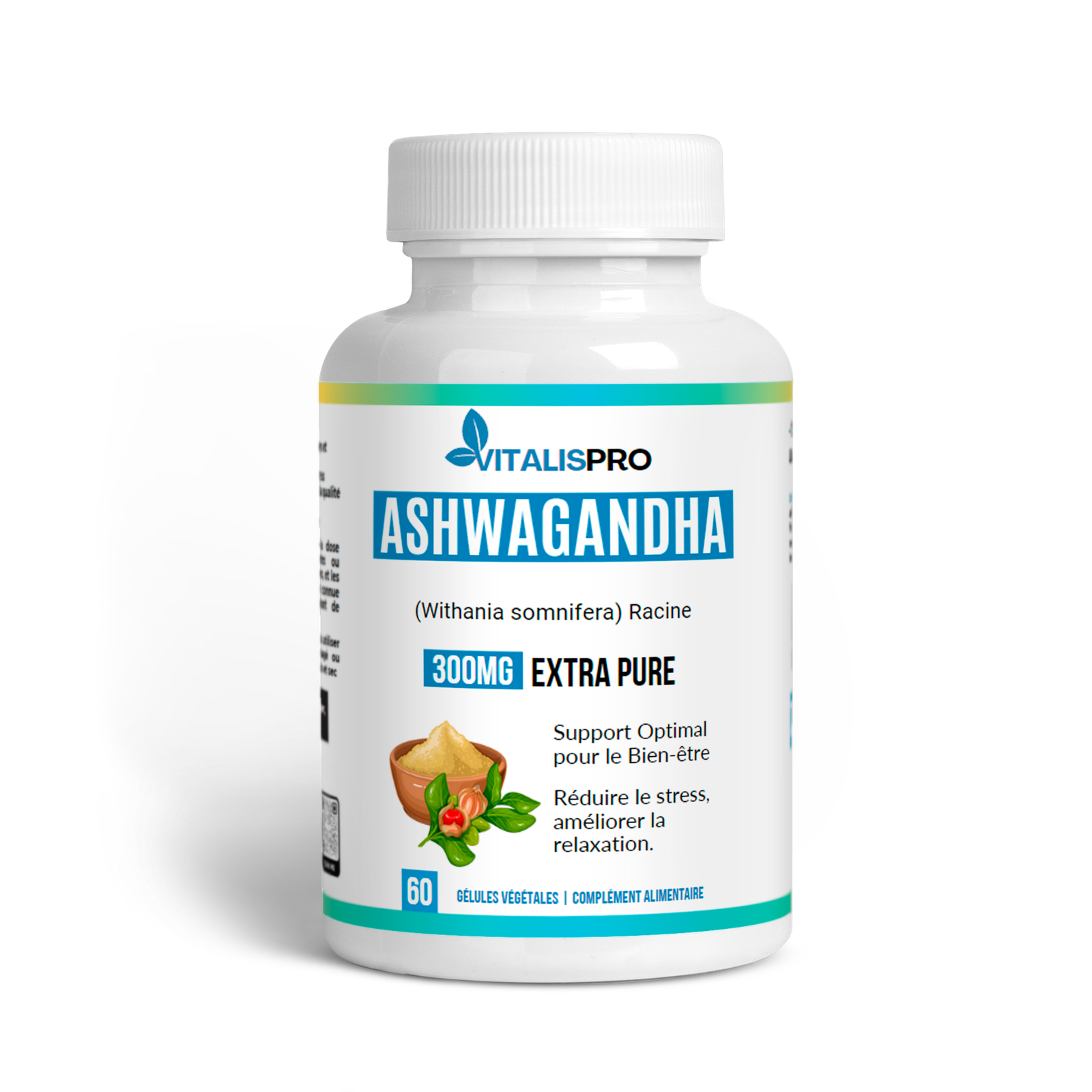
Ashwagandha (Withania somnifera) is a so-called “adaptogenic” plant, used for centuries in the Ayurvedic tradition and now studied by modern research. A randomised, placebo-controlled clinical trial examined an ashwagandha root extract in adults reporting sleep difficulties and anxiety, and noted favourable signals on the quality of rest and the sense of tension.2 Another trial observed an effect on stress-related markers in adults under everyday pressure.5
Here again, caution is in order: these studies are promising but their scale remains limited, and ashwagandha is presented as a plant that supports the body against daily pressure, to be woven into a broader wellbeing approach, not as a treatment. That is how we present it: for what it is, without loading it with promises science has not made.
5-HTP: a natural precursor
5-HTP is a natural compound, traditionally extracted from the seeds of Griffonia simplicifolia, that the body uses in its own pathways linked to mood and sleep. It is often chosen as part of an evening ritual, taken away from meals. As with any supplement, it is not an instant solution but a possible support within healthy habits — and it deserves, even more than others, to be taken with discernment and not stacked with other products without informed advice.
The smarter approach is not to gather boxes, but to choose with clarity. Among these elements, ashwagandha holds a special place for anyone looking to cope better with the pressure of daily life.
Caffeine and screens: two quiet enemies of sleep
An afternoon coffee may seem harmless, but the effect of caffeine lingers for several hours in the body and can hold back deep sleep at night without your ever making the connection. The practical rule is simple: make sure your last cup of coffee is taken before mid-afternoon. In a country where tea and coffee set the rhythm of the day and of hospitality, this is not a ban but an adjustment of timing that protects your nights.
As for screens, they emit a light that fools the brain and holds back the natural sleep hormone. Reserve the last hour before bed for calm activities, away from the phone: reading, meditation, or a peaceful family conversation. These simple changes are sometimes more effective than any supplement — a truth worth stating plainly, even when one offers products.
Evening food: what you eat matters
Dinner influences the quality of your night more than we imagine. Heavy or very fatty meals just before bed put the digestive system to work and hinder deep rest. Try to eat a light dinner at least two hours before you go to bed, and avoid large amounts of sugar that can cause energy swings during the night.
Some light foods, such as a little warm milk or a small handful of nuts, are favoured by many as part of a calm evening ritual. The Moroccan table, rich in vegetables, pulses and herbs, offers lovely options for a light, balanced dinner. The point is not a rigid rule, but moderation and good timing: a measured meal, eaten early enough, prepares sleep far better than a late feast.
A twenty-minute evening ritual
You do not need a complicated system. A short ritual, repeated every evening, is enough to send your body the signal that rest is near. Here is a concrete example, built around twenty minutes or so:
| The step | Why it matters | The concrete gesture |
|---|---|---|
| Lower the lights | Dimness favours natural melatonin | Dim the lamps half an hour before bed |
| Put the phone away | Less blue light, less mental stimulation | Place the screen outside the bedroom |
| A calming warm drink | A comforting gesture that marks the transition | A herbal tea or warm milk, without too much sugar |
| Slow breathing | It activates the relaxation of the nervous system | Five minutes of 4-4-6 breathing |
| Reading on paper | It occupies the mind without exciting it | A few pages of a book, away from the screen |
| Consistency | Repetition creates an automatic habit | The same sequence, at the same time |
Repeat this ritual every day so it becomes a landmark your body recognises. Consistency turns these gestures into an automatic habit that improves your sleep, gently and gradually. And for anyone who wants to complete this ritual with considered natural support, VitalisPro has brought its flagship elements of calm together in a set designed to go hand in hand with good sleep hygiene.

Precautions, interactions and limits
No responsible discussion of a food supplement is complete without a frank section on its limits. “Natural” is not an automatic synonym for “suitable for everyone in all circumstances,” and awareness of this is part of respecting your health. Elements that support sleep and calm are generally well tolerated in healthy adults at usual doses, but caution is required in specific situations:
- Pregnancy and breastfeeding: it is advised to avoid supplements unless recommended by a healthcare professional.
- Children under 18: supplements are not intended for this group without supervision.
- Ongoing treatments (particularly for mood, thyroid or anxiety): consult a professional before starting, as some elements may interact with medication.
- Do not stack several new supplements at the same time: introduce them one by one so you can tell what actually suits you.
The golden rule: a supplement adds; it does not fix a real imbalance on its own, and it does not diagnose or treat a condition. Most passing sleep difficulties improve with good habits and better stress management. But if sleep problems persist for weeks despite a regular ritual, or if they come with marked exhaustion that affects your daily life, consulting a qualified healthcare professional remains the safest and first option. Listening to your body and asking for advice when needed is not a weakness: it is a smart form of self-care. For any question, the VitalisPro team is available through our contact page.
Stories from our readers
These are testimonials from people who reviewed their evening habits and added natural support to their routine; individual experiences that differ from one person to another, which we present as they are, without exaggeration:
“I would toss and turn for hours before sleep, my mind racing. I did not look for a miracle: I fixed my times, moved the phone away and added magnesium in the evening. After a few weeks, I fall asleep more calmly. No magic, but a difference I can feel.” — Khalid, Casablanca
“What I liked was the honest message: no promise of instant sleep, just support within a lifestyle. I have been taking ashwagandha for two months, with a calmer evening ritual, and I handle work pressure better.” — Nawal, Rabat
“Ordering was easy, payment was on delivery, and the formulas are clear and ONSSA-authorised. I appreciate that it is natural and transparent, and I reordered.” — Youssef, Marrakech
Frequently asked questions about sleep and stress
Conclusion: what do we take from all this?
Restorative sleep and stress management cannot be declared into being: they are prepared, evening after evening, through simple and consistent habits. The best thing you can offer your nights is not a wonder product, but a stable evening ritual, steady times, fewer screens and less caffeine late in the day, and a few minutes of conscious calm. This is the real care: daily, quiet, and free of noise.
Within this frame, natural elements such as magnesium, ashwagandha and 5-HTP can be an interesting support — with promising signals, presented honestly for what they are. If you choose to add them, choose a clear, authorised formula from a transparent source, such as Magnesium Glycinate and Ashwagandha by VitalisPro. Wellbeing is built through knowledge and habits, not through promises.
In the end, what distinguishes the aware consumer is not avoiding every supplement nor believing every promise, but the ability to discern: to know what science says and what it does not, to place the fundamentals before the add-ons, and to give the body its fair time. If you leave this guide with a calmer evening ritual, we have reached our goal, whether or not you choose our products. For direct contact, the VitalisPro team is available through the our team page.
Sources and methodology
This guide relied on a review of documented general scientific sources (PubMed databases) and published clinical trials, in addition to official bodies such as the European Food Safety Authority (EFSA) and public-health authorities. We committed to presenting results at their true size: promising signals are presented as signals, not as definitive promises, and no therapeutic effect was claimed. The information here is for health education, not for diagnosis or a medical prescription.
References
- Centers for Disease Control and Prevention (CDC) — “About Sleep” (sleep regularity and health). cdc.gov
- Efficacy and safety of an ashwagandha (Withania somnifera) root extract in insomnia and anxiety: a double-blind, randomised, placebo-controlled study (2019). PubMed 31728244
- The effect of magnesium supplementation on primary insomnia in the elderly: a double-blind, placebo-controlled clinical trial (2012). PubMed 23853635
- European Food Safety Authority (EFSA) — scientific opinion on magnesium-related claims (nervous system, psychological function, tiredness). efsa.europa.eu
- Stress-relieving actions of an ashwagandha (Withania somnifera) extract: a randomised, double-blind, placebo-controlled study (2019). PubMed 31517876
- Association of magnesium intake with sleep duration and sleep quality: the CARDIA study (2022). PubMed 34883514
The information in this article is provided for informational purposes for health education, drawing on documented general scientific references (PubMed, EFSA and public-health authorities), and is not a substitute for consulting a qualified healthcare professional. Sleep- and calm-support products are food supplements that do not replace a varied, balanced diet or a healthy lifestyle, and are not intended to diagnose, treat, cure or prevent any condition. Do not exceed the recommended dose. Pregnant and breastfeeding women, children under 18, and people with medical conditions or ongoing treatments are advised to consult a professional before use. Keep out of the reach of children.
