


Wellbeing and natural balance
Few plant compounds have attracted as much scientific attention in recent years as berberine. This golden-yellow molecule, extracted from several traditional plants, has become the subject of dozens of studies exploring its role in the body’s sugar metabolism. But amid all this interest, solid facts get tangled up with hasty promises. This guide from VitalisPro is here to separate them: what the research genuinely shows about berberine and blood-sugar balance, in a calm, responsible tone that talks about function, never about miracles.
We are not selling you a “fix-everything capsule.” Instead, in plain language and with sourced references, we explain what berberine is, why it fascinates researchers, how it is studied in the context of blood-sugar balance, and where the honest limit of the evidence lies. The goal is that you leave with a decision built on knowledge, not on the advertising noise of social media.
Let us set one principle from the start: however promising some studies are, berberine remains a supporting element within a balanced lifestyle, not a substitute for a healthy diet or for the guidance of a healthcare professional. It is precisely from this realistic angle that talking about supplements begins to make sense, and not a moment before. Keep that compass in mind as you read on.
محتوى الصفحة
- 1 In brief: what you will learn
- 2 In this guide
- 3 What is berberine?
- 4 Berberine and sugar metabolism: what do the studies say?
- 5 How does berberine work in the body?
- 6 Berberine does not replace your lifestyle
- 7 The role of chromium in blood-sugar balance
- 8 Dose and absorption: why timing matters
- 9 Berberine in the Moroccan context
- 10 Telling a lab study apart from real life
- 11 How to fit berberine into your routine
- 12 Precautions, interactions and limits
- 13 Stories from our readers
- 14 Frequently asked questions about berberine
- 15 Conclusion: berberine in its proper frame
- 16 Sources and methodology
In brief: what you will learn
- Berberine is an active plant compound (an alkaloid) found in the roots and bark of several traditional plants; its golden-yellow colour is its signature.
- It is studied in the context of blood-sugar balance and carbohydrate metabolism; several systematic reviews report interesting signals while calling for larger trials.
- The most studied mechanism runs through an enzyme called AMPK, a kind of cellular “energy switch”; a more recent research angle also explores a link with the gut microbiome.
- Berberine does not replace your lifestyle: the plate — fewer fast sugars, more fibre, movement, sleep — remains the foundation. Chromium, for its part, contributes to the maintenance of normal blood glucose, according to EFSA.
- VitalisPro products such as Berberine 500 mg, Chromium Picolinate and the Berberine & Chromium Pack are ONSSA-authorised food supplements; they are not medicines and not a substitute for professional advice.
What is berberine?
Berberine is an active plant compound from the alkaloid family, found in the roots and bark of several plants used in traditional medicine for centuries. Its most visible feature is its colour: a bright golden yellow that was once used to dye fabrics. But it is not this ancient history that explains today’s research interest. What put berberine in the spotlight are the results that began to emerge in laboratory work, and later in some clinical trials, around its role in several of the body’s metabolic pathways.
This is exactly what sets berberine apart from many other plant compounds: it is not merely a traditional ingredient, it is the object of active scientific investigation. Dozens of teams across several continents have looked at how this compound interacts with energy metabolism. That sustained curiosity is a signal in itself: it suggests something worth understanding is going on — without meaning that every answer is already written.
A word of vocabulary for what follows: when we speak of “sugar metabolism” or “blood-sugar balance,” we mean the way the body manages the glucose from food — how it uses it as fuel, stores it, and keeps a stable level in the blood. It is a finely tuned system, shaped above all by what we eat and how we live. It is within this system that berberine is studied as a possible supporting factor, not as a pilot taking over the controls.
Berberine and sugar metabolism: what do the studies say?
This is the most explored field. A recent systematic review and meta-analysis, pooling several randomised controlled trials, examined the effect of berberine on markers of glucose metabolism and reported favourable signals on some of them, while stressing the need for larger, higher-quality trials.2 Another review, focused on metabolic profiles, reached a similar conclusion: encouraging indications, paired with an explicit call for caution in interpretation.3
It is essential to place this work in its proper frame. Most of it was carried out in patients and in medical settings, often alongside supervised care. It therefore cannot be translated into a promise, for a healthy person, that a capsule will “fix” their sugar or replace good habits. In these studies berberine is examined as a supporting element of normal metabolism, to be set within a broader whole — not as a stand-alone treatment. This distinction is not a legal detail; it is the very heart of the honesty we owe you.

A “signal” is not “definitive proof”
Why all this caution if the signals are there? Because rigorous science carefully distinguishes a signal from established proof. A signal is an encouraging result that points in a direction; proof is that same result confirmed at scale, reproducibly, in well-conducted studies. Much of what you read about “plants that regulate sugar” inflates a signal until it is presented as a certainty. Our job is to place every signal at its correct rank: interesting, worth following, but not yet a firm promise. That balance between curiosity and rigour is exactly what we want to convey to you.

How does berberine work in the body?
Researchers are exploring several possible mechanisms. The most studied involves an enzyme pathway known by the abbreviation AMPK. You can picture it as a kind of “energy switch” inside the cell: when it is activated, the cell tends to make better use of the available glucose and energy. Experimental work has shown that berberine activates this AMPK pathway, with metabolic effects observed in laboratory models.4 It is this mechanism that scientists link to berberine’s supporting role in metabolism.
To understand the frame all of this sits in, the MedlinePlus medical library (U.S. National Library of Medicine) offers a reliable entry point on how the body manages blood sugar day to day. That said, our understanding is still a work in progress: the full picture of berberine’s mechanisms remains an area of active research. This scientific humility is part of a responsible approach — we prefer to say “here is what we observe” rather than “here is what is proven once and for all.”
Berberine and the microbiome: a newer research angle
Among the most recent avenues is the possible link between berberine and the microbiome, meaning the community of beneficial bacteria that lives in the gut. Some work explores the hypothesis that part of berberine’s effects may pass through its action on this microbial ecosystem, given how closely gut health and overall metabolism are tied together.5 This angle is promising, but still in the exploration phase: above all, it reminds us that the body is an interconnected system, where sugar balance meets gut health, nutrition and sleep in a single network. That is why a holistic approach always beats a fixation on one single ingredient.
Berberine does not replace your lifestyle
This is a point worth hammering home, because it is decisive. Whatever the studies show, berberine is a supporting element within a whole, never a solution on its own. The foundation of blood-sugar balance always stays on the plate and in the lifestyle: cutting fast sugars, adding fibre, favouring whole carbohydrates, moving after meals, sleeping enough, and learning to manage stress. The World Health Organization reminds us that reducing added sugars and increasing fibre are among the pillars of a balanced diet.
Plant compounds come to complement this solid foundation, not to replace it. Anyone looking for a “magic pill” to erase unbalanced habits is looking in the wrong direction — and will always be disappointed. Conversely, whoever lays down the fundamentals first, then adds considered support consciously, gives that support every chance of meaning something. It is this simple but often-forgotten hierarchy that separates a mature approach from an impulsive purchase.
“The best ally of your blood-sugar balance is not a capsule: it is your plate, your evening walk and your sleep. Berberine can support that effort, but it never replaces it. A supplement adds; it does not build the house on its own.”
The role of chromium in blood-sugar balance
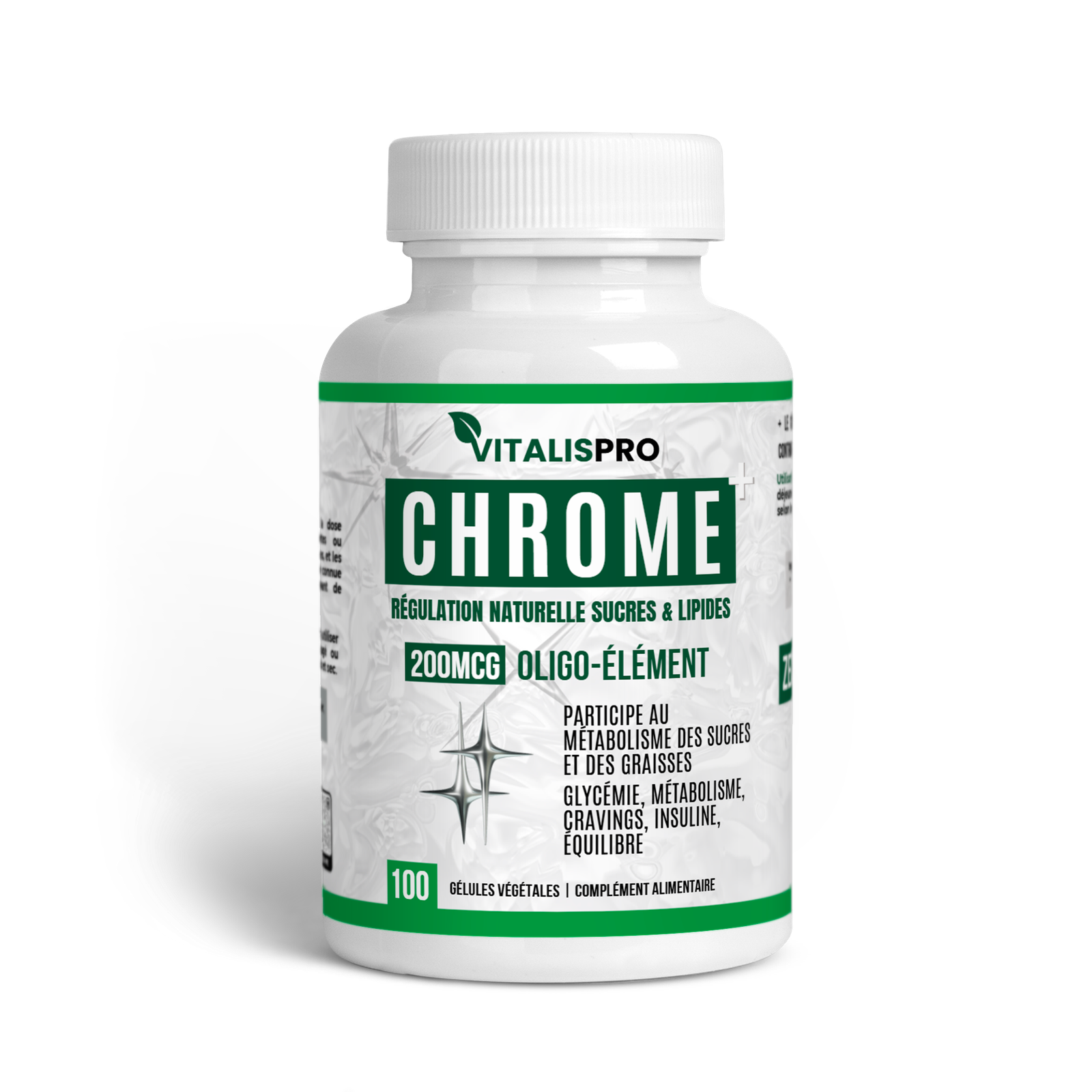
Alongside berberine, one trace element deserves a clear mention: chromium. Unlike many plants whose claims have not been approved, chromium benefits from health claims recognised by the European Food Safety Authority (EFSA): it contributes to normal macronutrient metabolism and to the maintenance of normal blood glucose. These are precise, regulated wordings that we use exactly as they stand — without stretching them into promises they do not carry.
This is why berberine and chromium are often considered together, in a logic of accompaniment: the former for the research interest it draws, the latter for its recognised contribution to normal metabolism, all set within a balanced lifestyle. It is not a race to stack boxes, but a considered pairing, where each element has a clear reason to be there. The soundest logic is always simplicity: a few chosen, authorised elements are worth more than ten obscure products piled up at random.
Dose and absorption: why timing matters
Berberine has a well-known feature: its relatively short life in the body. That is why many programmes prefer to split the daily dose across several intakes rather than one, often with meals or just before. This split helps keep a steadier level throughout the day. Berberine is also typically used over a continuous period of several weeks before assessing what it brings. Following the instructions on the box is the rule: smart use begins with the right dose, at the right time.
To help you find your bearings, here is a practical table summarising the principles of measured use — always to be adapted to the exact instructions on the product’s label:
| Principle | Why it matters | A practical step |
|---|---|---|
| Split the intake | Berberine has a short life in the body | Divide the dose across the day, with meals |
| Take with meals | Mealtime naturally aligns with metabolism | At the start of or during the meal, with water |
| Use over time | The benefit is built through consistency, not a single dose | A continuous programme over several weeks |
| Follow the label | The approved dose ensures safe, consistent use | Never exceed the recommended dose |
| Pair with the plate | The supplement supports; it does not replace the fundamentals | Fibre, whole carbohydrates, movement after meals |
Berberine in the Moroccan context
No discussion of sugar metabolism can be judged apart from the way we eat, and the Moroccan context has its own character. Our tables are generous and sweet: honey pastries, sugared tea, bread at every meal, and a prized place for starches. These are precious cultural pleasures, but they call for a little attention when they become the daily norm. Talking about blood-sugar balance in Morocco therefore means, first of all, talking about our real habits — with kindness and without guilt.
The good news: our culinary heritage is full of allies. Pulses — lentils, chickpeas, broad beans — seasonal vegetables, olive oil and fresh herbs are precious resources for a more balanced eating pattern. There is no need to import foreign “diets”; it is often enough to give our table back its share of fibre and vegetables, and to moderate the fast sugars that have gained ground. It is on this deeply Moroccan foundation that any complementary support takes on meaning. You can browse our full range designed in this spirit in our shop.
Telling a lab study apart from real life
When you read a headline announcing a “new study,” it helps to know which type of study it is. Laboratory studies, on cells, give valuable clues but do not guarantee the same result in a whole human body. Animal studies come closer, without being decisive. Clinical trials in humans are the nearest to reality, but they vary in size and quality. And at the top of this pyramid, the systematic review pools dozens of studies to draw out an overall trend.6
This is why serious scientific reviews almost always end with the phrase “further research is needed.” Far from being an admission of weakness, that sentence is a mark of scientific honesty. The wise approach reads berberine’s results with the same discernment: encouraging indications, worth following, within a frame of humility — not clear-cut promises. This clarity protects you from exaggeration in both directions: the kind that oversells, and the kind that dismisses without examination.
How to fit berberine into your routine
Step one: start with the plate, not the box
Your first “support” for blood-sugar balance is your plate. Before buying any supplement, review a week of your meals honestly: where are the fast sugars, where is the fibre and where are the vegetables missing, and where could a little movement after a meal fit in? A simple adjustment here comes before everything, and it makes whatever follows far more useful.
If you decide to add support, choose a formula with clear ingredients and a stated dose, authorised by ONSSA, from a source that is transparent in what it offers and in its price. An authorised product gives you a guarantee of oversight that a product of unknown origin, entering through informal channels, never will. Here, clarity is part of safety.
Step three: respect the dose and consistency
Do not exceed the recommended dose on the box thinking that “more is better”: the body responds to consistency, not to shock doses. With berberine, remember to split the intake at mealtimes, and tie it to a fixed daily habit so you do not forget it. Any potential benefit is built through steady use over weeks, not through a passing capsule.
Step four: observe your body, then decide
After a sufficient period, assess your general sense objectively: your energy, your comfort after meals, your consistency in good habits. Quietly listening to your body — without magical expectations — is the best judge. And at any doubt, or if you are on medication, consulting a healthcare professional remains the priority. For any question, the VitalisPro team is available through our contact page.
Precautions, interactions and limits
No responsible discussion of a food supplement is complete without a frank section on its limits. Despite its plant origin, berberine is an active compound with real effects, which calls for conscious use. “Natural” is not an automatic synonym for “suitable for everyone in all circumstances.” Caution is required in specific situations:
- Pregnancy and breastfeeding: berberine is generally not advised; avoid it unless recommended by a healthcare professional.
- Children and teenagers under 18: supplements are not intended for this group without supervision.
- Ongoing treatment or a known condition: it is essential to consult a qualified healthcare professional before starting, to avoid any possible interaction with your medication.
- Digestive sensitivity: like any active compound, berberine may cause discomfort in some people; hence the value of respecting the dose and splitting the intake.
We add a practical reminder that is often forgotten: do not start several new supplements at the same time. If you begin them together, it becomes hard to know what helped you and what may have caused any discomfort. The smarter method is to introduce one element at a time, giving it enough time to observe. This calm, gradual approach protects both your health and your wallet, and makes your experience clearer and more honest. And remember: this article is educational; it is meant to help you understand the subject and ask a professional the right questions, not to diagnose a situation or prescribe an individual programme.
Stories from our readers
These are testimonials from people who first reviewed their habits, then added plant support to their routine; individual experiences that differ from one person to another, which we present as they are, without exaggeration:
“I started with the simplest things: less white bread, more vegetables, a walk after dinner. I added Berberine 500 mg with meals, without expecting a miracle. What I appreciate is VitalisPro’s honest message: support, not a promise. I feel more consistent with my good habits.” — Karim, Fes
“What reassured me was the clarity of the dose and the ONSSA authorisation. I took the Berberine & Chromium Pack alongside a real effort on my diet. I am not looking for a shortcut: I am looking for clean support, and that is what I found.” — Nadia, Casablanca
“Ordering was easy, payment on delivery, and a team that answers questions without overselling. I reordered, because the approach is transparent and because I stay in charge of my own habits.” — Hamid, Tangier
Frequently asked questions about berberine
Conclusion: berberine in its proper frame
After this journey, the picture becomes clearer. Berberine is a plant compound that deserves the interest it draws, thanks to growing research on its role in supporting normal sugar metabolism. But a mature understanding puts it back in its proper place: a supporting element within a whole, not an isolated magic solution. The foundation of balance always stays on the plate and in the lifestyle — fewer fast sugars, more fibre, movement, sleep, stress management — and berberine comes to complement that foundation, when needed and after professional advice.
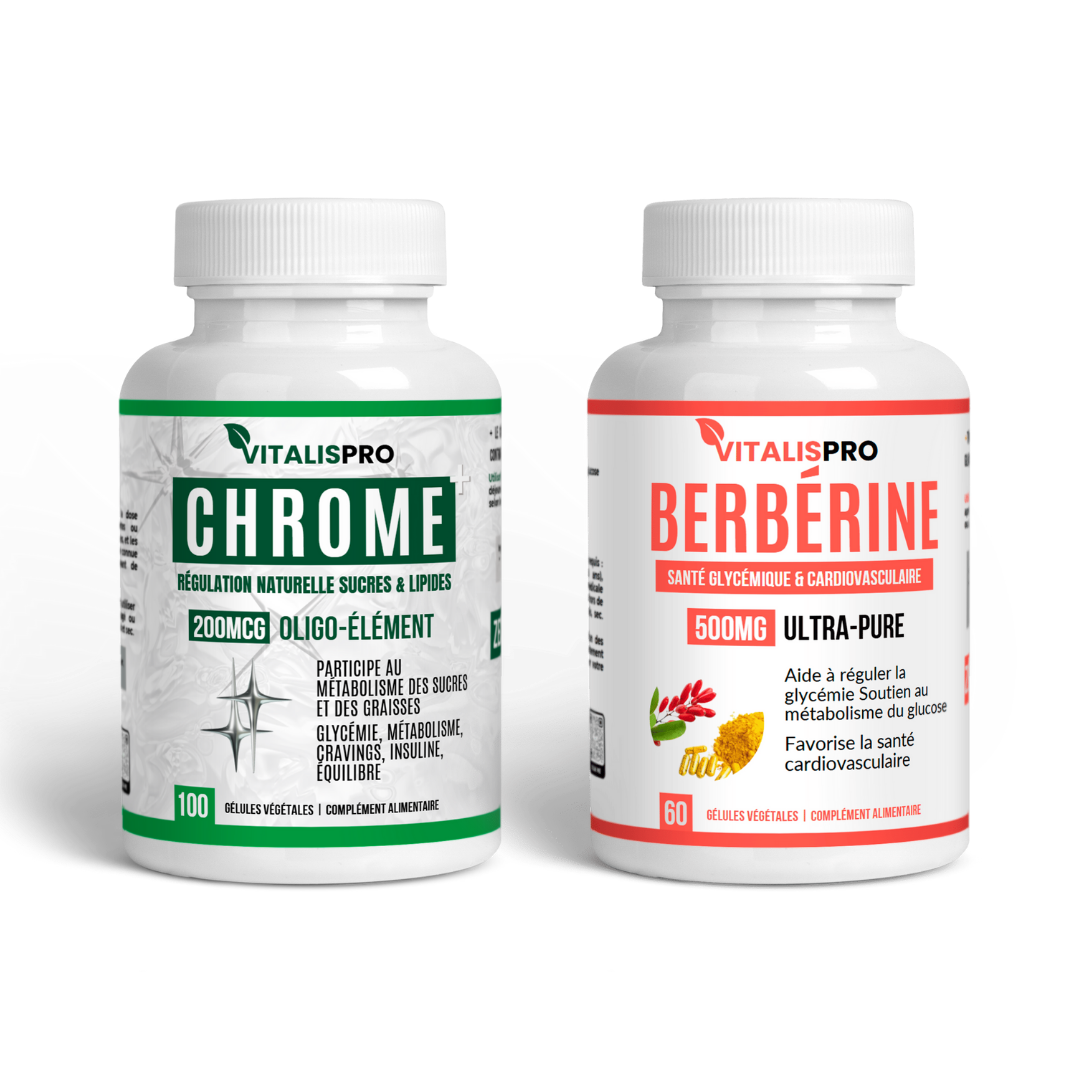
Wise use combines two qualities: appreciating what the studies say, and staying humble before what we do not yet know. It is this balance that lets you make responsible use of this compound, far from both overselling and unjustified dismissal. If you choose to add support, opt for a clear, authorised formula from a transparent source, such as Berberine 500 mg and the Berberine & Chromium Pack by VitalisPro. For direct contact, the team is available through our team page.
Sources and methodology
This guide relied on a review of documented general scientific sources (PubMed databases) and published systematic reviews, in addition to official bodies such as the U.S. National Library of Medicine (MedlinePlus/NIH), the World Health Organization (WHO) and the European Food Safety Authority (EFSA). We committed to presenting results at their true size: promising signals are presented as signals, not as definitive promises, and no therapeutic effect was claimed. The information here is for health education, not for diagnosis or a medical prescription.
References
- U.S. National Library of Medicine — MedlinePlus, “Blood Sugar.” medlineplus.gov
- Glucose-lowering effect of berberine on type 2 diabetes: a systematic review and meta-analysis (2022, Frontiers in Pharmacology). PubMed 36467075
- The effect of berberine on metabolic profiles in type 2 diabetic patients: a systematic review and meta-analysis of randomised controlled trials (2021). PubMed 34956436
- Berberine, a natural plant product, activates AMP-activated protein kinase (AMPK) with beneficial metabolic effects (2006, Diabetes). PubMed 16873688
- Blood-glucose-lowering effect of Coptidis Rhizoma extracts (a source of berberine) via gut-microbiota modulation, animal model (2021). PubMed 34211397
- Efficacy and safety of berberine on the components of metabolic syndrome: a systematic review and meta-analysis of randomised placebo-controlled trials (2025, Frontiers in Pharmacology). PubMed 40740996
- European Food Safety Authority (EFSA) — health claims (chromium and normal blood glucose); World Health Organization — healthy diet. efsa.europa.eu · who.int
The information in this article is provided for informational purposes for health education, drawing on documented general scientific references (PubMed, NIH, WHO and EFSA), and is not a substitute for consulting a qualified healthcare professional. Berberine and chromium are food supplements that do not replace a varied, balanced diet or a healthy lifestyle, and are not intended to diagnose, treat, cure or prevent any disease. Do not exceed the recommended dose. Berberine is not advised for pregnant or breastfeeding women or for those under 18; people with medical conditions or ongoing treatments are advised to consult a professional before use. Keep out of the reach of children.
