


Wellbeing and natural defences
At the first cold days of winter and the small tirednesses of the season, an ancient name returns to Moroccan homes: propolis, known in Arabic as “العكبر.” It is one of the oldest products of the hive, valued for accompanying immunity and soothing the throat. But what exactly is propolis? What does the research really say? And how do you use it wisely?
This in-depth guide from VitalisPro sells you no miracle. In plain language and with sourced references, it explains what propolis is and what it is made of, what science has — and has not — shown about its role in supporting natural defences and throat comfort, how to choose and use it, and what precautions to keep in mind. The goal is a decision built on knowledge, not on advertising noise.
Let us agree on one principle from the start: propolis is a supportive element, not a medicine or a “cure” that would replace a healthy lifestyle or medical advice. Its value is understood inside a healthy routine: sleep, food, hydration and rest. It is precisely from this realistic angle that talking about propolis makes full sense.
محتوى الصفحة
- 1 In brief: what you will learn
- 2 In this guide
- 3 What is propolis (the hive’s “gold”)?
- 4 Propolis and immunity: what does the research say?
- 5 Propolis, the throat and winter comfort
- 6 How to use propolis: forms, dosage, timing
- 7 Choosing your propolis: source and quality
- 8 Propolis in the Moroccan context
- 9 Precautions, allergies and limits
- 10 Fitting propolis into your routine
- 11 Reader experiences
- 12 Frequently asked questions about propolis
- 13 In conclusion: what to take away
- 14 Sources and methodology
In brief: what you will learn
- Propolis (العكبر) is a resin that bees make from tree buds to protect the hive; it is sometimes nicknamed the colony’s “shield.”
- Its value lies in its rich composition: more than 300 identified molecules, including flavonoids and polyphenols with studied antioxidant properties.1
- Research links propolis to immune support and throat comfort: promising signals, but still preliminary evidence that calls for caution.3
- Quality, source and dosage matter more than the word “propolis” on the label: composition varies with region and source plant.
- VitalisPro’s propolis products are ONSSA-authorised food supplements, meant to fit inside a healthy lifestyle; they replace neither a balanced diet nor professional advice.
What is propolis (the hive’s “gold”)?
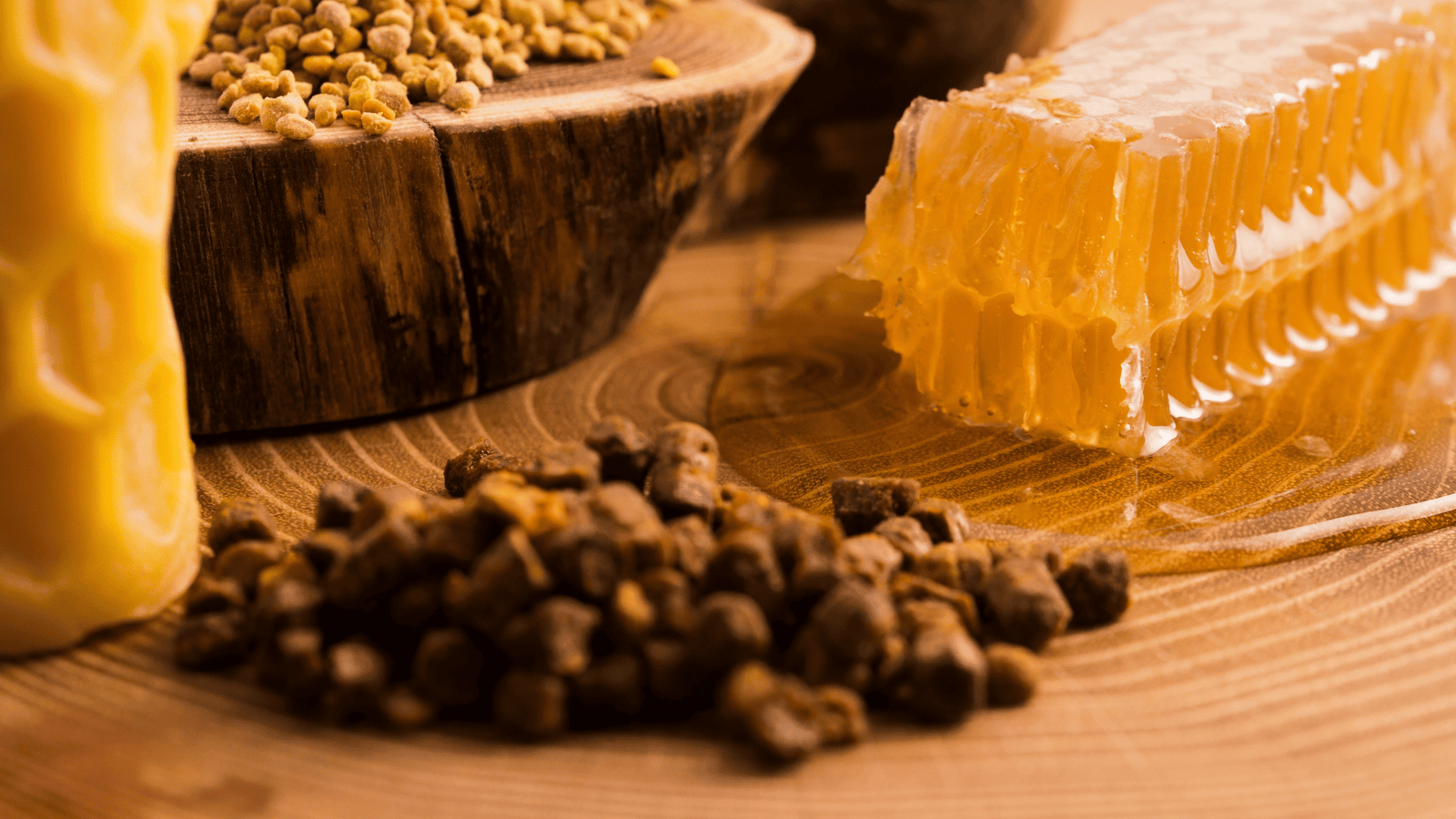
Propolis, known in Arabic as “العكبر,” is a resinous material that bees gather from the buds and bark of certain trees, then mix with their own secretions and hive wax. Bees use it to seal cracks, sanitise the cells and protect the colony from micro-organisms. It is this protective role that earned it, in popular language, the nickname “the hive’s natural antibiotic” — a vivid image, but one to handle with care, because propolis is not an antibiotic in the medical sense.
Its colour tends towards greenish or dark brown, and its resinous smell is distinctive. But the essential is not its appearance: it is its composition. Analyses have identified more than 300 different compounds in propolis, foremost among them flavonoids (such as galangin and chrysin), phenolic acids and various polyphenols.1 These molecules concentrate the interest of research, notably for their antioxidant properties.
One point deserves highlighting right away: the composition of propolis varies greatly with the geographic region and the vegetation whose resins the bees have foraged. Propolis from one area does not have exactly the same profile as another. This is why source clarity and manufacturing quality become essential criteria when choosing — we will come back to this in detail later.
An ancient tradition, a recent scientific interest
Propolis is not a modern discovery. It appears in the traditional uses of many Mediterranean civilisations, where it was employed for its supposed sanitising and preserving virtues. What is new is the scientific gaze turned on it over the past few decades: researchers seek to understand, molecule by molecule, what tradition attributed broadly to the “bees’ resin.” This back-and-forth between old knowledge and modern verification is exactly the spirit in which we approach propolis: with respect for tradition, and demand for evidence.
It also helps to place propolis alongside the hive’s other treasures, so as not to confuse them. Honey is the bees’ energy store, royal jelly is the food reserved for the queen, and propolis is the protective resin of the structure. Each has its own profile and its own uses. Understanding this distinction is the first step to choosing well, because a product that clearly states what it contains, and in what amount, is always more trustworthy than a vague label that leans on the general prestige of the hive without saying exactly what is inside.
Propolis and immunity: what does the research say?
What propolis is most often associated with is immune support. This interest is explained by its studied properties as an antioxidant and modulator of the immune response. A scientific review devoted to propolis and the immune system surveyed the available work and noted that its compounds may interact with certain cells and mechanisms of innate immunity, accompanying the balance of the body’s response.1 This is one of the reasons many turn to it in the cold season.
A more recent synthesis on natural ingredients meant to support immunity placed propolis among the substances of interest, alongside other plant actives, stressing the consistency of its antioxidant properties with a role in supporting natural defences.3 Here too, the idea is not that propolis “boosts” immunity as if by magic, but that it provides compounds whose antioxidant action fits into a larger whole.
A word on what “antioxidant” actually means, in plain language: our cells naturally produce reactive molecules, sometimes called free radicals, and the body has its own systems to keep them in balance. Antioxidant compounds, like the flavonoids found in propolis, are studied for the way they participate in that balance. This is a helpful mechanism to understand, but it is also where marketing tends to overreach: having antioxidant properties in a laboratory dish is not the same as producing a measurable health effect in a person. Keeping those two levels apart is precisely what separates honest information from a sales pitch.
Let us be honest about the level of evidence: the picture is promising but preliminary. A good part of the results comes from laboratory studies and reviews that explicitly call for more clinical trials in humans before any firm claim. Propolis therefore presents itself as a supportive element, to be integrated into a healthy lifestyle, and not as a treatment. Scientific authorities, including the European Food Safety Authority EFSA, strictly frame health claims and have not retained specific ones for propolis in this context.4 We therefore present it for what it is: a precious tradition, with interesting but unfinished research.
“Propolis is not a magic wand for immunity. It is support from the hive, whose antioxidant compounds are studied seriously: promising, but in its right place, within a healthy lifestyle, and never in place of medical advice.”
Propolis, the throat and winter comfort
One of the most widespread uses of propolis concerns throat comfort, especially at the first signs of seasonal discomfort. Thanks to its studied soothing properties, it is traditionally used as a spray, lozenges to suck, or drops, to soothe a sensitive, irritated throat. It is a familiar reflex in many homes as soon as temperatures drop.
A scientific update devoted to the anti-inflammatory activities of propolis gathered the data on its compounds and their action on inflammation mechanisms, noting a consistency between its molecules (flavonoids, polyphenols) and a soothing role.2 This work nourishes the traditional interest in propolis for the comfort of the ENT sphere, while reminding that these are results to be confirmed and not an established therapeutic effect.
The common-sense rule stays the same: propolis can accompany the comfort of a sensitive throat, but it does not replace the advice of a healthcare professional. If symptoms intensify, persist or come with fever, consulting a professional remains the first reference. Propolis is comfort support, not a treatment.
Why the enthusiasm in winter in Morocco?
In the cold, damp season, between daily commutes and the density of Moroccan cities, exposure to small seasonal ailments increases. Many families then turn to propolis as seasonal support in the winter routine, alongside rest, good nutrition and warm drinks. It is no coincidence: propolis belongs to that heritage of simple gestures passed from one generation to the next, and which modern research now examines with curiosity. What we ask of it is reasonable: a little help holding a healthy routine together through the season, not a shield against every winter ailment. Set with that expectation, propolis rarely disappoints, because it is asked to do only what it can honestly do.
How to use propolis: forms, dosage, timing
Propolis comes in several forms, each with its practical use:
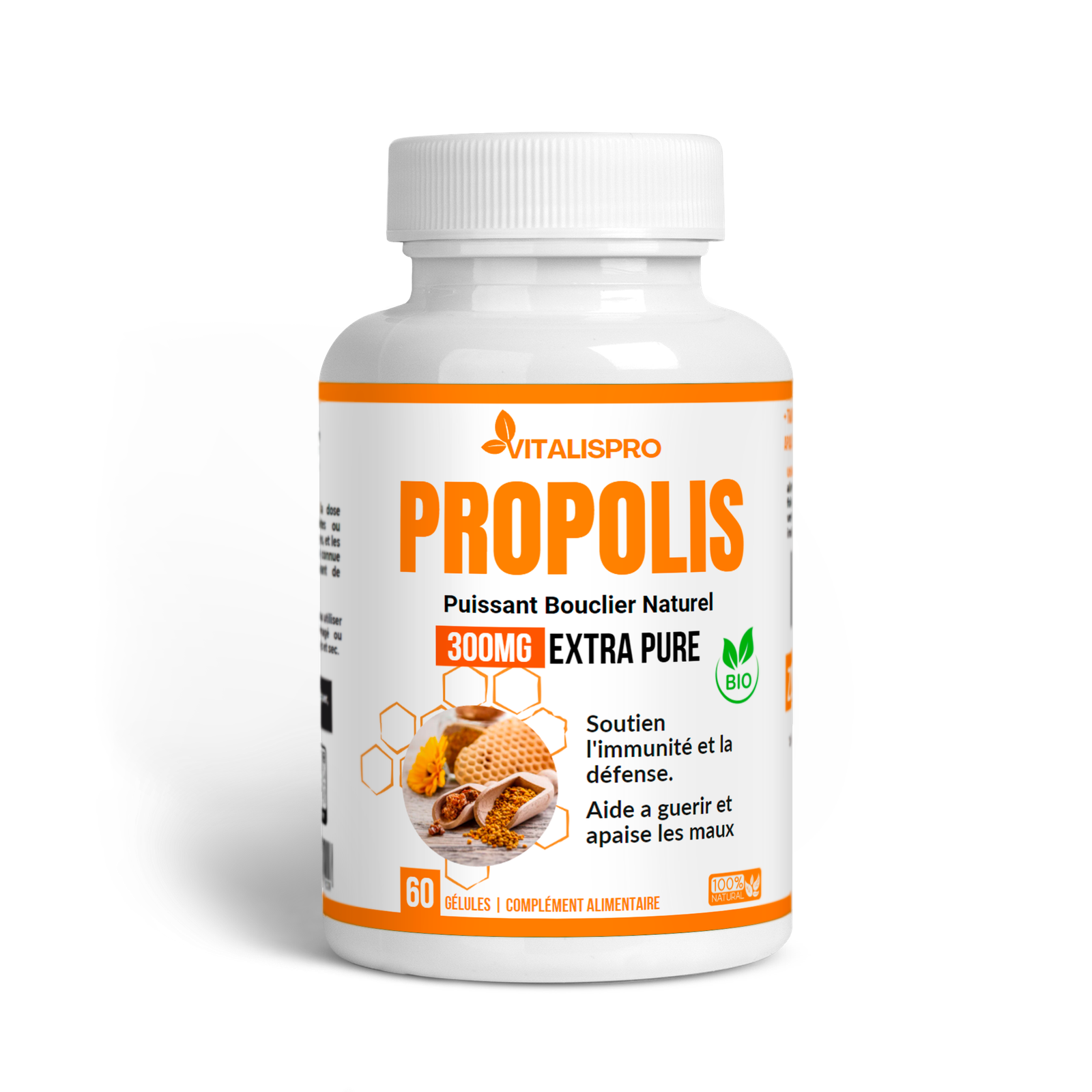
- Capsules: the form best suited to regular daily use to accompany immunity, with a clear, easy-to-follow dose.
- Spray and lozenges: the most practical for local throat comfort, to use as needed.
- Tincture (drops): to dilute in warm water or honey, favoured by those who like traditional preparations.
As for the practical principles of use, a few simple markers are enough:
- Always follow the recommended dose on the product label: it varies with concentration and form.
- Preferably take capsules with a meal, for better digestive comfort.
- Favour consistency over several weeks during the cold season, rather than high, spaced-out doses.
- Start with a small amount to test your body’s tolerance, especially if this is your first experience with hive products.
| The form | Main use | A practical marker |
|---|---|---|
| Capsules | Daily immune support | A regular intake with a meal, over several weeks |
| Spray / lozenges | Local throat comfort | To use occasionally, as needed |
| Tincture (drops) | Versatile traditional use | To dilute in warm water or honey |
How long should you continue?
There is no universal duration. Many adopt propolis as seasonal support during the winter weeks, or when they feel the first signs of tiredness. What matters is listening to your body, following the packaging instructions, and stopping to consult a professional in case of an unusual reaction. Any possible benefit builds through consistency, not haste.

Choosing your propolis: source and quality
A point many overlook: the word “propolis” on the box is not enough. Because its composition varies with region and source plant, what really counts is the clarity of the source, the richness in active compounds (notably flavonoids), the honesty of the stated dose and the quality of manufacture. Propolis of unknown origin, arriving through informal channels, may deliver only a fraction of what you think you are buying.
This is why we always insist on ONSSA regulatory authorisation (the National Office for the Sanitary Safety of Food Products). It is not a mere formality: it is a control pathway that concerns the product’s safety and compliance. An authorised supplement offers you a guarantee that a product sold without traceability never will. Here, clarity is part of safety.
Another principle we defend: simplicity and clarity rather than accumulation. Some consumers, chasing a faster result, stack many boxes from various sources, convinced that “more is better.” The reality is often the opposite: chaotic accumulation raises the bill, complicates follow-up and increases the risk of interactions. A single, thoughtful, authorised formula is worth more than five obscure boxes. To explore our full wellbeing range, our shop presents formulas designed in this spirit of clarity.
Propolis in the Moroccan context
No discussion of propolis can be judged outside the way of life, and the Moroccan context has its own specificity. Our winters, especially in damp regions and large cities, come with heightened exposure to small seasonal ailments. Add to this busy rhythms of life, where sleep and food sometimes take a back seat. All of this makes supporting natural defences a subject worth genuine awareness, and not only at the heart of winter.
In the face of this, your body does not need a “shock solution,” but a calm return to the fundamentals: enough sleep, balanced meals rich in seasonal vegetables and fruit, good hydration and comforting warm drinks. Propolis adds to this whole as a support — one more brick on a solid base — and not as a shortcut that would excuse healthy habits.
There is, moreover, a fine Moroccan tradition around hive products: honey holds a place of choice in our heritage, and propolis is its natural extension. There is no need to import foreign “recipes”: it is enough to give these simple gestures their full place, with the added guarantee of a product whose source and dosage are clear. For any question, the VitalisPro team remains reachable, and you can meet the people behind the brand on our team page.
It is worth adding that the seasonal logic matters as much as the product itself. Winter in Morocco is not a single moment but a stretch of several weeks, and the value of a supportive routine lies in its steadiness across that stretch, not in a burst of effort at the first sneeze. This is why we speak of propolis as a companion to the season rather than a rescue remedy: something you fold quietly into your mornings, alongside a warm drink and a good night’s sleep, and keep up with modest, honest expectations.
Precautions, allergies and limits
No responsible discussion of a food supplement is complete without a frank chapter on limits. Because “natural” is not automatically synonymous with “suitable for everyone in every circumstance.” Propolis is generally well tolerated in healthy adults at usual doses, but caution applies in specific situations:
- Allergy to bee products: this is the main point of attention. People allergic to honey, pollen or bee stings may react to propolis; it is advisable to test a small amount beforehand.
- Pregnancy and breastfeeding: safety data are insufficient; it is best to avoid it and ask a healthcare professional.
- Children and people on medication: professional advice is recommended before any use, to avoid any interaction.
Let us add a practical tip that is often forgotten: do not start several new supplements at the same time. If you begin them together, it becomes hard to know what helped you, what changed nothing, and what may have caused discomfort. The wiser method is to introduce one element at a time, giving it enough observation time. This calm progression protects both your health and your budget.
The golden rule: a supplement adds; it does not on its own correct a real imbalance, does not diagnose and does not treat a condition. At the slightest persistent or worrying symptom, consulting a healthcare professional remains the safest and first option. We are here to accompany you with a clear, authorised product, not to replace the doctor.
Fitting propolis into your routine
First step: lay the fundamentals first
The first “immune support” is your habits. Before adding any supplement, review your week: are you sleeping enough? Do your meals make room for seasonal vegetables and fruit? Are you drinking enough water? A simple adjustment here precedes everything else, and makes what comes next far more useful.
If you decide to add propolis, choose a formula with a transparent source, rich in active compounds and authorised by ONSSA. An authorised product offers you a control guarantee that an item of unknown origin never will. Here again, clarity is part of safety, and a fair price goes with fair quality.
Third step: respect the dosage and consistency
Do not exceed the recommended dose on the box, thinking that “more is better”: the body responds to consistency, not to shock doses. Generally take capsules with a meal, and tie this intake to a stable daily habit so you do not forget it. Any possible benefit builds through consistency over weeks.
Fourth step: observe your body, then decide
After a sufficient period, assess objectively your general feeling, your comfort and your seasonal energy. Calmly listening to your body — without magical expectations — is the best judge. And at the slightest doubt or persistent symptom, consulting a healthcare professional stays the priority. For any question, the VitalisPro team is reachable via our shop and team pages.

Reader experiences
Here are testimonials from people who have added propolis to their winter routine; individual experiences that vary from one person to another, presented as they are, without exaggeration:
“Every winter, I felt a little seasonal tiredness. I did not look for a miracle: I looked after my sleep, added fruit and took propolis capsules with meals. I appreciated the honest tone, without exaggerated promises.” — Khadija, Fez
“What I liked was the clarity: an ONSSA-authorised formula, a precise dose, an explained source. I take propolis as support during the cold season, within habits I am trying to improve.” — Amine, Casablanca
“The order was simple, with cash on delivery. I chose the pack with royal jelly, and I appreciate that everything is transparent: the source, the price and the use. I have reordered.” — Salma, Rabat
Frequently asked questions about propolis
In conclusion: what to take away
Propolis (العكبر) is one of the oldest products of the hive, and an interesting supportive element for immunity and throat comfort in the winter routine. But it is neither a medicine nor a miracle solution. Its antioxidant compounds, such as flavonoids, are the subject of serious research: promising signals, presented honestly for what they are, without inflating them for the sake of a sale.
If you choose to add propolis to your habits, opt for a clear formula, with a transparent, authorised source, like those in our shop. Start with a small amount, follow the packaging instructions, favour consistency, and consult a professional if needed. Because wellbeing is built through knowledge and habits, not through promises; and we believe customer trust is built through clarity, not exaggeration.
Sources and methodology
This guide relied on a review of documented general scientific sources (PubMed databases) and published reviews, in addition to official bodies such as the European Food Safety Authority (EFSA). We committed to presenting results at their true size: promising signals are presented as signals, not as definitive promises, and no therapeutic effect was claimed. The information here is for health education, not for diagnosis or a medical prescription.
References
- Sforcin JM. Propolis and the immune system: a review. PubMed 17580109
- Recent Update on the Anti-Inflammatory Activities of Propolis (2022). PubMed 36500579
- Natural Ingredients to Improve Immunity (2023). PubMed 37111285
- European Food Safety Authority (EFSA) — health claims. efsa.europa.eu
The information in this article is provided for informational purposes for health education, drawing on documented general scientific references (PubMed and EFSA), and is not a substitute for consulting a qualified healthcare professional. Propolis is a food supplement that replaces neither a varied, balanced diet nor a healthy lifestyle, and is not intended to diagnose, treat, cure or prevent any condition. Do not exceed the recommended dose. People allergic to bee products should be cautious. Pregnant and breastfeeding women, children, and people with medical conditions or ongoing treatments are advised to consult a professional before use. Keep out of the reach of children.
