


Wellbeing, calm and natural balance
You have probably heard that magnesium glycinate is “the best form” of magnesium. But few people really know why. In this calm, educational guide, VitalisPro explains what magnesium glycinate is, how it differs from the other forms (bisglycinate, citrate, oxide), what the research says about its role in sleep, relaxation, the muscles and fatigue, along with a sensible dose, the best time to take it, and the precautions to know. The goal is not to sell you promises, but to give you what you need to decide with awareness, on the basis of verifiable sources.
Magnesium is one of the most heavily used minerals in the human body: it takes part in hundreds of reactions, from producing energy to the function of the muscles and nerves. Yet the mineral alone is not enough. What truly matters is the form in which it reaches you and how your body absorbs it. This is exactly where glycinate comes in: a way of delivering magnesium that aims for two concrete qualities — good uptake and great gentleness on the stomach.
Let us set an honest frame from the start. A magnesium supplement is not a medicine, not a sleeping pill, and not a miracle solution. It is a food supplement that fits inside a balanced lifestyle: a varied diet, regular sleep, movement and hydration. Magnesium can support normal functions of the body — and that is already a great deal — but it does not replace a healthy plate, nor the advice of a healthcare professional when a problem persists. It is in this spirit, without exaggeration, that we approach the subject.
So we will clearly separate what science has shown from what it has not yet established, place every “benefit” at its correct rank, and recall the only health claims that are actually authorised for magnesium in Europe. You will leave with a clear picture of what magnesium glycinate can, and cannot, offer.
محتوى الصفحة
- 1 In brief: what you will learn
- 2 In this guide
- 3 What is magnesium glycinate?
- 4 The difference between magnesium forms: glycinate, citrate, oxide
- 5 The benefits of magnesium glycinate according to science
- 6 Absorption and digestive comfort: the real difference
- 7 Magnesium in the Moroccan context
- 8 Dosage and the best time to take it
- 9 Precautions, interactions and limits
- 10 How to fit magnesium glycinate into your routine
- 11 Stories from our readers
- 12 Frequently asked questions about magnesium glycinate
- 13 Conclusion: an informed decision, not promises
- 14 Sources and methodology
In brief: what you will learn
- Magnesium glycinate (often called bisglycinate) is a “chelated” form: magnesium is bound to the amino acid glycine, which gives it two practical strengths — good absorption and great gentleness on the stomach.
- Not all forms are equal: oxide is cheap but poorly absorbed, citrate is well absorbed but can loosen the bowel at higher doses, while glycinate combines uptake with digestive comfort.
- Magnesium contributes to normal muscle function, to the normal function of the nervous system, to the reduction of tiredness and fatigue, and to normal psychological function: these are claims authorised at the European level, not promises of a cure.
- Glycinate is often chosen in the evening to accompany relaxation; consistency over several weeks matters more than a single high dose.
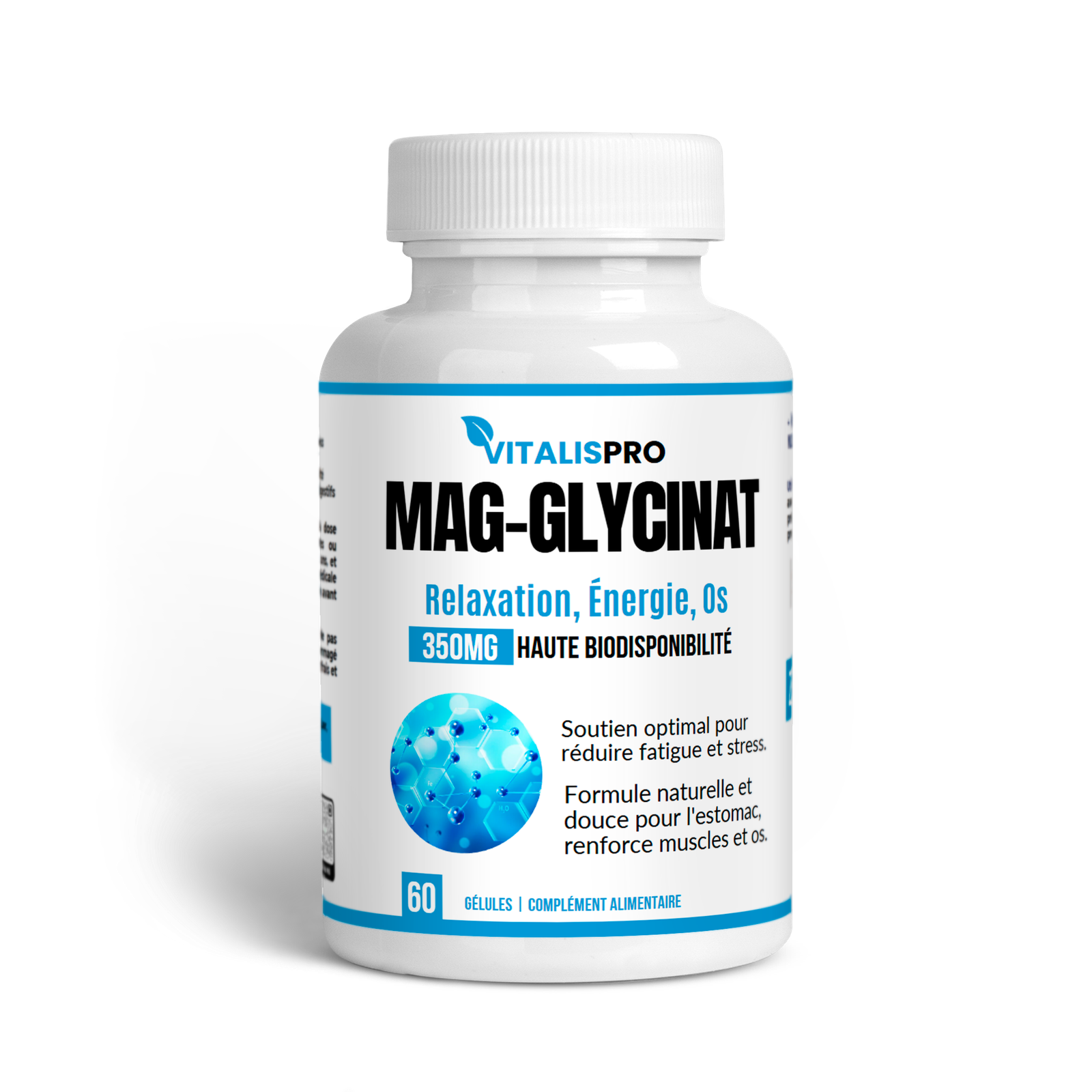
- VitalisPro’s Magnesium Glycinate 350 mg is an ONSSA-authorised food supplement, meant to fit inside a healthy lifestyle; it is not a medicine and not a substitute for professional advice.
What is magnesium glycinate?
Magnesium is an essential mineral: our body cannot make it, so it has to come from food or a supplement. It is involved in more than three hundred enzyme reactions, from turning food into energy to muscle contraction and the transmission of nerve signals. But one detail changes everything: magnesium never exists “on its own.” In a supplement, it is always paired with another molecule that carries it, and it is this pairing that defines the “form.”
Magnesium glycinate — or more precisely bisglycinate — refers to magnesium bound to two molecules of glycine, an amino acid. This particular bond has a name: chelation. Picture glycine as two small pincers that wrap around the magnesium atom and escort it across the intestinal wall. This escort spares it from competing with other minerals and shields it from the acidic conditions of the stomach.
This structure explains the two qualities people look for: good bioavailability (the share actually absorbed and usable) and a high digestive tolerance. According to a scientific update on magnesium absorption, organic salts bound to amino acids tend to show higher solubility than inorganic salts, which may translate into better availability of the mineral.2 For a general overview of magnesium, its roles and intakes, you can consult the reference fact sheet from the NIH Office of Dietary Supplements.1
Glycinate or bisglycinate: are they the same thing?
In everyday language, “glycinate” and “bisglycinate” refer to the same family. The prefix “bis” simply signals that two molecules of glycine surround each magnesium atom. You will therefore see both terms on labels; what matters is not the word, but the clarity of the dose of elemental magnesium and the transparency of the source. That is why we always state the real amount of magnesium and the product’s regulatory authorisation.
The difference between magnesium forms: glycinate, citrate, oxide
This is probably the most frequent question: what is the difference between the forms of magnesium, and which one suits me? The forms are not equal, neither in absorption nor in their effect on digestion. The table below sums up the most useful practical distinctions, without needless jargon:
| The form | Absorption | Digestive comfort | Common use |
|---|---|---|---|
| Glycinate (bisglycinate) | Good | Usually gentle | Sleep, relaxation, long-term daily use |
| Citrate | Good | May loosen the bowel at higher doses | General support, bowel regularity |
| Oxide | Relatively low | May cause intestinal discomfort | Inexpensive, sometimes used as a laxative |
| Marine / hydroxide | Variable | Variable between individuals | General intake, mainstream blends |
The practical conclusion is simple. If your goal is to support relaxation and sleep with great gentleness on the stomach, glycinate is the form many people prefer. Oxide is the cheapest, but its absorption is the weakest; it is sometimes used for its effect on the bowel more than to “top up” magnesium. Citrate is a good compromise, provided you tolerate its possible mild laxative effect. That said, needs vary from one person to another, and a balanced diet — leafy greens, pulses, nuts, whole grains — remains the first source of magnesium.
To go further into the criteria of a trustworthy supplement — a clear composition, an honest dose, regulatory authorisation — you can browse our whole range on the VitalisPro shop, where every page shows its composition transparently.
Why “elemental magnesium” is the number that counts
One point deserves special attention, because it is where many products quietly mislead: the figure on the label is not always the amount of magnesium you actually receive. A capsule may state a large total weight of “magnesium bisglycinate,” yet the elemental magnesium — the fraction the body can truly use — is only a part of that weight. This is exactly why comparing two products on their headline number alone can be deceptive. What you should look for is the clearly stated amount of elemental magnesium per dose, expressed in milligrams, so that you know what you are really buying. A transparent formula gives you that figure plainly; an opaque one hides it behind an impressive-looking total. This is a principle of honesty we hold to, because a supplement is only worth its price when it delivers what it claims.
Here is a short educational video that gives an overview of magnesium and its role in health:
The benefits of magnesium glycinate according to science
Before the benefits, an essential clarification: a supplement is not a medicine and does not replace treatment. What we describe here are studied nutritional roles and health claims authorised at the European level for magnesium under Regulation (EU) 432/2012.5 This regulation recognises, in particular, that magnesium contributes to normal muscle function, to the normal function of the nervous system, to the reduction of tiredness and fatigue, to a normal energy-yielding metabolism, and to normal psychological function. Nothing more, nothing less.
Magnesium glycinate and sleep
Many people link a lack of magnesium to fragmented sleep. In a double-blind clinical trial in elderly people with insomnia, magnesium supplementation was associated with an improvement in some sleep indicators compared with placebo.3 Let us be precise: this is a modest-sized study, in a specific population, and not proof that magnesium “treats” insomnia. Beyond that, glycine itself — the amino acid bound to magnesium in glycinate — is studied for its role in relaxation, which makes this form especially appreciated by those seeking a moment of calm before bed.
Magnesium is not a sleeping pill: it does not knock you out. It contributes to the normal function of the nervous system, which, in someone whose intake is insufficient, may accompany a calmer inner climate. It is a support, not a switch.
Magnesium glycinate, stress and relaxation
A systematic review examined eighteen studies on magnesium, subjective anxiety and stress. Its authors concluded that the data “suggest a beneficial effect on self-reported anxiety” in populations exposed to it, while stressing the need for higher-quality trials.4 This does not make magnesium a “treatment for anxiety”: it indicates that closing a deficit may support normal psychological function. The nuance is crucial, and we hold to it: an encouraging signal is not a therapeutic promise.
For those seeking extra support against everyday stress, magnesium fits inside an overall lifestyle: regular sleep, physical activity, daylight exposure and moments of recovery. The supplement accompanies these habits; it does not replace them.
Magnesium glycinate, muscles and cramps
Magnesium takes part in normal muscle contraction and relaxation; that is why some athletes link an insufficient intake to muscle discomfort or cramps. Drawing on the “normal muscle function” claim recognised in Europe, an adequate magnesium status is an element that supports movement and muscle comfort within a balanced lifestyle — and not a substitute for a proper warm-up, suitable recovery and good hydration.
Energy and the reduction of fatigue
Among the authorised claims is magnesium’s contribution to the reduction of tiredness and fatigue and to a normal energy-yielding metabolism. Magnesium indeed takes part in activating ATP, the “energy currency” of our cells. It is therefore logical that an insufficient intake is sometimes accompanied by a sense of fatigue, especially during stress or short sleep. Be careful, though: fatigue has many possible causes (iron deficiency, thyroid, sleep, lifestyle). If it persists, professional advice is needed to identify its real origin.
Absorption and digestive comfort: the real difference
The most concrete strength of magnesium glycinate lies in its bond with glycine, which helps it cross the intestinal wall without strong competition from other compounds. A larger amount therefore reaches the bloodstream. This same mechanism explains its digestive gentleness: glycinate is less likely to loosen the bowel or cause cramps than oxide or citrate at higher doses, which makes it suitable for sensitive stomachs and for prolonged daily use.
This is a difference that matters day to day. A magnesium that is poorly absorbed and poorly tolerated often ends up abandoned after a few days of discomfort. A gentle form, by contrast, slots easily into a routine and allows consistency — and it is precisely consistency, over several weeks, that matters most with minerals. Comfort is not a luxury: it is what makes staying with it possible.
“With minerals, it is not the spectacular one-day dose that makes the difference, but the quiet constancy of several weeks. A well-tolerated form is a form you keep taking — and that is already half the way there.”
Magnesium in the Moroccan context
No nutrition topic can be judged out of its context, and ours has its own character. The pace of life has quickened, meals are sometimes eaten in a hurry, and modern eating — richer in refined and processed products — tends to be poorer in magnesium than the traditional cuisine built on pulses, leafy greens and nuts. Add to that everyday stress and nights that are sometimes cut short, two factors that weigh on our inner balance.
The summer heat deserves a mention too. With heavy sweating, the body loses minerals, and we do not always think to make up for it with suitable hydration and food. This is no reason to panic or to pile up supplements: it is above all an invitation to return to the fundamentals — drinking enough, putting vegetables and pulses back at the centre of the plate, and considering thoughtful support if needed.
The good news is that our culinary heritage is full of natural sources of magnesium: lentils, chickpeas, almonds, dried figs, leafy vegetables and cocoa. Giving these foods their place again is already taking action. The supplement comes next, as a support, for anyone who chooses to add it consciously. You will find our full range on the VitalisPro shop.
Dosage and the best time to take it
The need for magnesium varies with age, sex, activity and diet, and the product label together with a professional’s advice remain the first reference. As general, practical guideposts:
- Respect the dose stated on the box and do not exceed it without a healthcare professional’s advice.
- Many prefer to take it in the evening, about an hour before bed, to accompany relaxation; it can be taken with a meal to limit any discomfort.
- Consistency over several weeks matters more than a single high dose: minerals work gradually and cumulatively.
- Avoid combining several supplements containing magnesium at the same time, so as not to exceed intakes.
- A large glass of water and a fixed moment of the day help you not to forget the dose and to build a lasting habit.
Let us recall an obvious point too often forgotten: “more” is not “better.” The body responds to constancy, not to shock doses. A measured, regular intake, paired with a good plate, is worth more than random stacking.
Precautions, interactions and limits
No responsible discussion of a supplement is complete without a frank section on its limits. Magnesium glycinate is generally well tolerated in healthy adults at usual doses, but caution is required in certain situations:
- Mild digestive effects: a looser bowel or a sense of bloating may appear at higher doses.
- Possible interactions with some medications (for example certain antibiotics, or blood-pressure or thyroid treatments): ask a professional for advice if you are on treatment.
- Kidney disease: magnesium can build up when its elimination is impaired; medical advice is essential.
- Pregnancy and breastfeeding, and people under 18: reserve for a healthcare professional’s advice.
The rule is simple: start with a measured dose, observe how your body responds, and stop if any unusual reaction appears. At any persistent or worrying symptom, consulting a healthcare professional remains the priority; we are here to accompany you with a clear, authorised product, not to replace the doctor. For any question, the VitalisPro team is available through our contact page.
How to fit magnesium glycinate into your routine
Step one: start with the plate
Your first “magnesium intake” is your diet. Before adding a supplement, review a week of meals: is there enough in the way of pulses, leafy greens, nuts and whole grains? A simple adjustment here comes before everything and makes the supplement far more useful.
If you decide to add a supplement, choose a form with clear ingredients, with the elemental magnesium dose shown transparently, and authorised by ONSSA. A gentle form such as bisglycinate makes daily consistency easier. A product of transparent origin gives you a guarantee of oversight that a product of unknown provenance never will.
Step three: build consistency, then observe
Tie the dose to a stable habit — the evening meal, for instance — so you do not forget it, and let several weeks pass before assessing. How is your general sense of relaxation and energy? Your sleep? Quietly listening to your body, without magical expectations, is the best judge.
And to place the topic in a wider frame, this educational video explains the unique benefits of magnesium glycinate and how it differs from other forms:
Stories from our readers
These are testimonials from people who reviewed their habits and added magnesium glycinate to their routine; individual experiences that differ from one person to another, which we present as they are, without exaggeration:
“I used to take a cheap magnesium that upset my stomach, so I had stopped. With glycinate, no discomfort at all: I take it in the evening, and after a few weeks I feel more relaxed at bedtime. No miracle, but a real difference in comfort.” — Nadia, Casablanca
“What I liked was the honest message: no promise of a cure, just support within a lifestyle. I take it after training, and my evenings are calmer. Ordering was easy, with cash on delivery.” — Youssef, Rabat
“The formula is clear, ONSSA-authorised, and the elemental magnesium is shown plainly. I appreciate that transparency, and I reordered so as not to break the routine.” — Salma, Marrakech
Frequently asked questions about magnesium glycinate
Conclusion: an informed decision, not promises
Magnesium glycinate is a well-absorbed, stomach-gentle form that delivers magnesium — a mineral that contributes to normal muscle and nerve function and to the reduction of fatigue. It may support relaxation and sleep in people who are short of it or going through periods of stress. But it is neither a medicine nor a magical solution.
VitalisPro commits to offering a product with a clear source and dose, because your decision deserves honest information. Read the label, start with a measured dose, build consistency, and consult a professional if needed. Whether or not you choose our products, if you leave this guide with the ability to discern what science says and what it does not, we have reached our goal. For a direct exchange, the VitalisPro team is available through our our team page.
Sources and methodology
This guide relies on documented, verifiable general scientific sources (PubMed databases), a clinical trial and a systematic review, as well as official bodies: the U.S. National Institutes of Health Office of Dietary Supplements (NIH) and the European framework for health claims (Regulation EU 432/2012). We committed to presenting results at their true size: promising signals are presented as signals, not as definitive promises, and no therapeutic effect was claimed. The information here is for health education, not for diagnosis or a medical prescription.
References
- National Institutes of Health, Office of Dietary Supplements — “Magnesium” fact sheet (health professionals). ods.od.nih.gov
- Schuchardt J.P. & Hahn A. — “Intestinal Absorption and Factors Influencing Bioavailability of Magnesium — An Update” (2017). PubMed 29123461
- Abbasi B. et al. — “The effect of magnesium supplementation on primary insomnia in elderly: a double-blind placebo-controlled clinical trial” (2012). PubMed 23853635
- Boyle N.B. et al. — “The Effects of Magnesium Supplementation on Subjective Anxiety and Stress: a Systematic Review” (2017). PubMed 28445426
- Regulation (EU) No 432/2012 establishing a list of permitted health claims made on foods (magnesium). eur-lex.europa.eu
The information in this article is provided for informational purposes for health education, drawing on documented general scientific references (PubMed, NIH and the EU health-claims Regulation), and is not a substitute for consulting a qualified healthcare professional. Magnesium bisglycinate is a food supplement that does not replace a varied, balanced diet or a healthy lifestyle, and is not intended to diagnose, treat, cure or prevent any condition. Do not exceed the recommended dose. Pregnant and breastfeeding women, children under 18, and people with a medical condition (notably of the kidneys) or ongoing treatments are advised to consult a professional before use. Keep out of the reach of children.
